California lawmakers are exploring regulatory changes that could expand the use of factory-built housing, a construction method officials say could help lower development costs and accelerate homebuilding across the state.
Modular and prefabricated housing methods have been used for decades, but lawmakers say outdated regulations have slowed the industry’s growth. Now, policymakers are examining ways to modernize rules and remove barriers that prevent builders from scaling these technologies.
The discussion comes as the state continues to struggle with high housing costs and a persistent shortage of affordable homes.
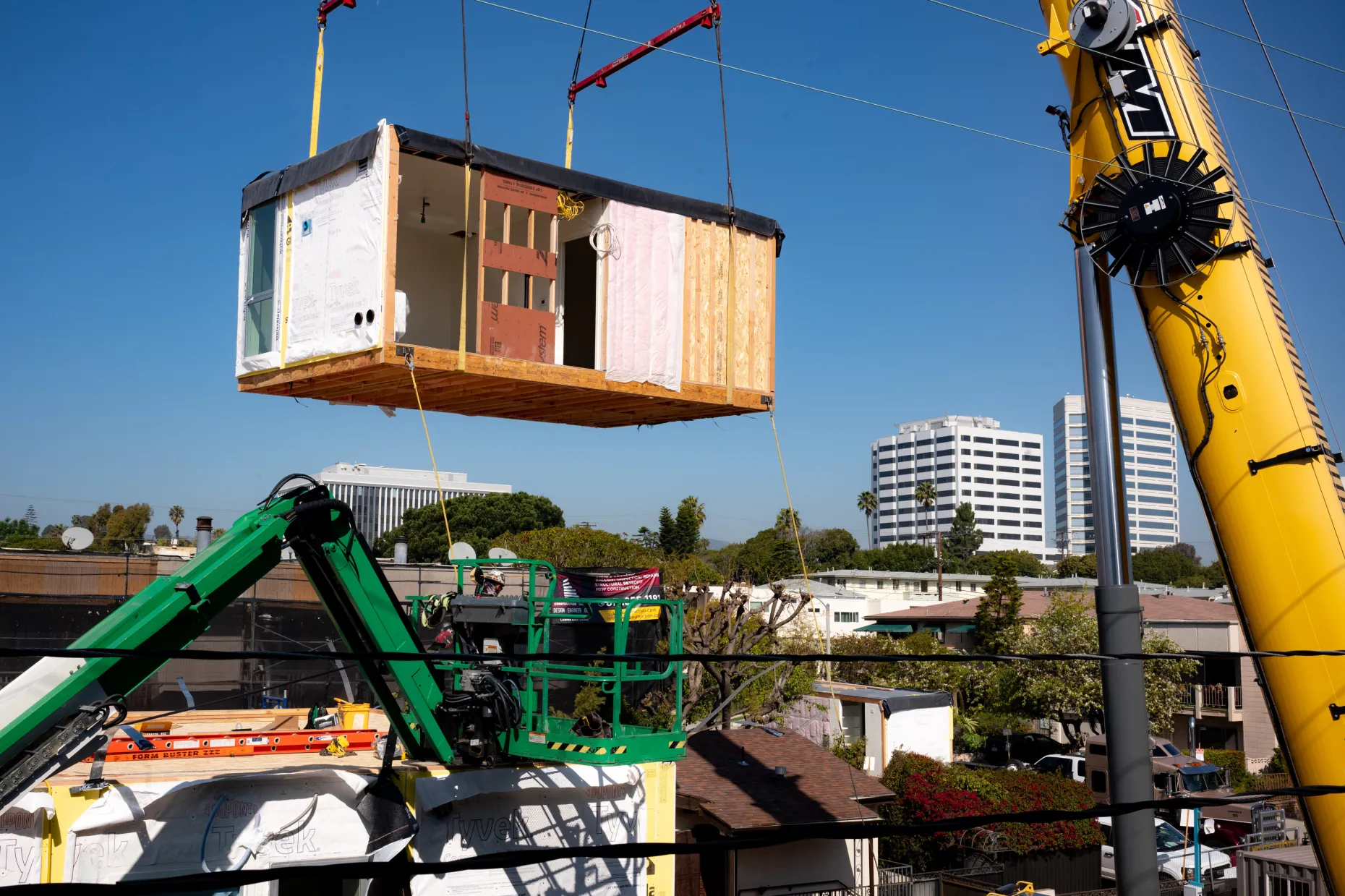
Tara Barauskas recently witnessed the benefits of modular construction firsthand when cranes lifted fully built rooms into place for the 13-unit Berkeley Station housing development in Santa Monica. The modular units were constructed about 70 miles away in San Bernardino County before being transported to the site.
The project cost roughly $9 million and delivered an unexpected benefit to the surrounding community by reducing construction disruptions.
“We’d been building affordable housing for many years and it’s just gotten increasingly more expensive and difficult to build,” Barauskas said. “So we wanted to try a different construction methodology.”
The modular approach shortened construction timelines and reduced labor expenses by roughly 30%, according to the nonprofit developer Community Corp. of Santa Monica.
Officials in the state legislature are now examining how policy changes could encourage wider adoption of factory-built construction.
A legislative committee on Housing Construction Innovation, chaired by Buffy Wicks, has identified several areas needing reform. These include financing structures, workforce development and standardized contracting processes for modular projects.
The committee’s work follows a series of permitting reforms enacted over the past year aimed at accelerating housing development, particularly in areas impacted by wildfires or dense urban redevelopment.
Lawmakers increasingly view factory-built housing as a promising strategy to reduce development costs while boosting housing production statewide.
“It’s not about having factories for the sake of having factories. It’s about having factories for the sake of bringing down the cost of housing,” Wicks said.
Her interest in the industry grew after visiting international and domestic regions where factory-built housing plays a larger role in residential construction.
Wicks said Sweden provides one example, where factory production accounts for a majority of new housing construction.
“We’re looking at how we can bring down the cost of construction, and by extension, bring down the cost of housing for my constituents and embrace these newer technologies,” Wicks added.
Although modular construction is gaining attention today, the concept is not new to California.
Prefabricated homes date back to the Gold Rush era, when preassembled structures were shipped from New York to rapidly expanding communities in the West.
Later, in the early 20th century, mobile homes and prefabricated housing gained popularity as automobiles and travel increased. Companies such as Sears even sold build-it-yourself houses through catalog orders, many of which still stand across Southern California cities.
Despite the long history, advocates say regulations have not evolved quickly enough to support modern factory-based housing technologies.
Today, companies like Plant Prefab are advancing modular construction using modern design and advanced manufacturing methods.
Founder Steve Glenn said the company customizes designs with architects before producing housing components inside factory facilities.
Demand for the company’s products has increased in recent years, particularly following major wildfire disasters across California.
Plant Prefab has helped rebuild homes in regions affected by fires in Napa Valley, Sonoma, Malibu and Agoura Hills.
“It’s one thing to get a bid from a general contractor that says here’s how long we expect it’ll take,” Glenn said. “It’s quite another to actually realize that schedule.”
Research from the Terner Center for Housing Innovation indicates that off-site construction methods can reduce building costs by 20% to 50%, depending on how much of the project is completed in factories rather than on-site.
Despite the advantages, modular housing developers still face challenges.
One major hurdle is financing. Developers often must invest more capital upfront because modular units are manufactured before traditional construction financing can be fully accessed.
Housing developer Paul Steidl, co-founder of BuildCasa, said modular construction offers speed but can require different financial planning.
“The projects may be quicker to build, but they often require more up-front capital,” Steidl said.
BuildCasa currently has several modular townhome developments underway across California.
State officials also emphasize the need for cities and counties to participate in regulatory reform if factory-built housing is to grow statewide.
“We need an all-of-the-above approach, and we need our cities to be active participants in helping to realize that all-of-the-above approach,” Wicks said.
Meanwhile, housing developers say modular construction remains promising but caution that rising demand could eventually push costs upward if supply chains become constrained.
“If you’re not careful, those things can vanish quite quickly in terms of cost savings,” Barauskas said.
Still, the experience has encouraged her to continue using modular construction in future developments.
“I would try it again,” she said.
Originally reported by Amancai Biraben in Los Angels Daily News.