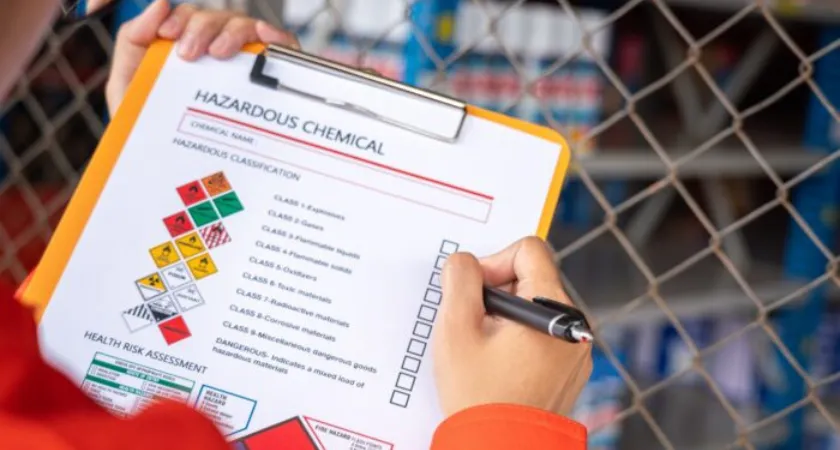
Chemical safety violations remain a widespread issue across U.S. workplaces despite decades of regulatory oversight, according to a new analysis of enforcement data from the Occupational Safety and Health Administration.
.avif)
The report, conducted by TraceOne, found that nearly 37,000 workers were denied access to proper chemical safety information over a five-year period, highlighting ongoing gaps in workplace protections.
Between 2021 and 2025, OSHA recorded 36,984 hazard communication violations nationwide, which equates to 5.6 violations per 100,000 workers across the United States.
Hazard communication rules require employers to inform workers about chemical hazards through labeling systems, training programs and Safety Data Sheets (SDS) that explain safe handling procedures.
However, enforcement data indicates that compliance problems remain concentrated in certain industries and regions.
States including **Maryland, Tennessee and Michigan recorded some of the highest totals of hazard communication violations during the five-year analysis period.
When adjusted for workforce size, the pattern shifts slightly, with Alaska reporting the highest rate at 44.7 violations per 100,000 workers, followed by Maryland and **Delaware.
Manufacturing and construction industries accounted for the largest share of violations identified in the report.
Together, the two sectors represented more than half of all OSHA hazard communication citations recorded between 2021 and 2025.
Manufacturing facilities were responsible for 10,021 violations, while construction sites produced 8,678 violations during the same period.
Other industries with violations included accommodation and food services, retail trade and public administration. Sectors with minimal chemical exposure—such as finance, insurance and information technology—reported far fewer infractions.
The data suggests that industries dealing with hazardous materials face greater challenges maintaining compliance with chemical safety regulations.
Despite accounting for a large share of OSHA inspections, the construction industry showed relatively lower rates of hazard communication violations compared with manufacturing.
Construction represented 42.8% of OSHA inspections, yet only 2.5% of those inspections uncovered hazard communication violations, according to the analysis.
Manufacturing presented a different trend. Although inspectors conducted fewer inspections compared with construction, 8.8% of manufacturing inspections identified violations, indicating deeper compliance challenges within factory environments.
One of the most common issues cited in the report involves missing or outdated Safety Data Sheets (SDS).
These documents provide essential information about chemical hazards, protective equipment requirements and emergency procedures. Without accessible SDS documentation, workers may lack the knowledge needed to prevent injuries such as chemical burns, respiratory illnesses, fires or explosions.
.webp)
While violations remain common, the report also highlights significant improvements in hazard communication compliance since the late 1980s.
Violations peaked in 1989, when OSHA recorded 37,134 citations shortly after the agency’s Hazard Communication Standard was fully implemented.
Since that time, enforcement data shows violations have declined by more than 83%, with approximately 6,130 citations issued in 2025.
Despite that long-term progress, thousands of violations still occur each year, often among small and mid-sized businesses that lack robust compliance systems.
Companies operating across multiple facilities may struggle to maintain accurate and up-to-date chemical safety documentation, increasing the risk of worker exposure and regulatory penalties.
For risk managers and insurance professionals, persistent hazard communication violations also represent significant financial exposure through workplace injury claims and OSHA penalties.
The report suggests that targeted safety initiatives in high-risk sectors—particularly manufacturing—could help reduce violations and improve chemical safety protections for workers nationwide.
Originally reported by R&I Editorial Team in Risk & Insurance