The construction industry is confronting a pivotal moment as emerging technologies, environmental pressures and workforce challenges force leaders to rethink how America builds.
A newly released report from a National Science Foundation-funded workshop, led by USC Viterbi School of Engineering, underscores the urgent need for deeper collaboration between academia, industry and federal agencies to guide that transformation.
Advances in robotics, artificial intelligence, digital twin technologies and new construction materials are rapidly reshaping the sector. While these innovations present major opportunities for productivity and safety improvements, they also introduce structural and organizational complexities that traditional research models may not adequately address.
At the center of this effort is the USC Sonny Astani Department of Civil & Environmental Engineering, where construction management research is increasingly focused on anticipating industry shifts rather than reacting to them.
Key questions are driving the conversation: How can construction engineering research evolve alongside technological disruption? What role should interdisciplinary collaboration play? And how can partnerships between universities and practitioners produce measurable, real-world impact?
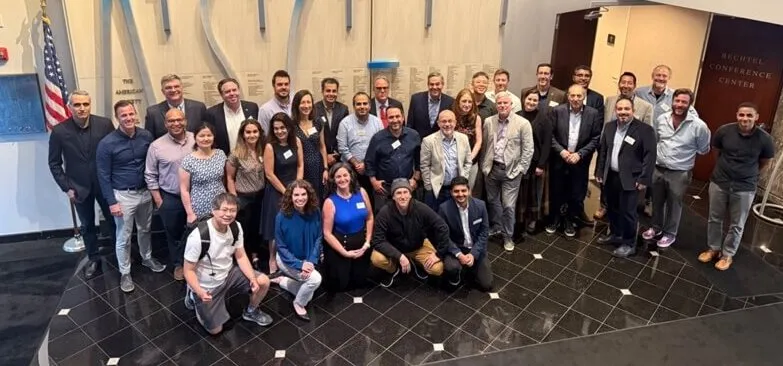
To address these issues, a specialized NSF-funded workshop was convened July 14–15, 2025, at the American Society of Civil Engineers Headquarters in Reston. Organized by Lucio Soibelman, Fred Champion Chair in Engineering and professor of civil and environmental engineering at USC, the gathering brought together leading experts from academia, professional associations and private industry.
Professor Soibelman’s research centers on construction informatics, project-based data integration, decision support systems and the interplay between technology and organizational practice. His work emphasizes that innovation in construction must reflect the realities of contracts, worksites and human behavior.
“This workshop represented a timely and strategic effort to realign construction engineering research with contemporary societal, environmental and technological needs,” said Soibelman.
Despite construction’s significant contribution to U.S. employment and economic output, the industry invests comparatively little in research and development. At the same time, it faces intensifying pressures from labor shortages, safety concerns, climate resilience demands and uneven technology adoption.
“The workshop was designed to move beyond general observations by identifying specific research gaps, framing foundational questions and clarifying where federal investment could have the greatest impact,” said Soibelman.
The two-day program included keynote talks, panel discussions, breakout sessions and facilitated conversations. Day one focused on establishing shared context — examining institutional roles, the integration of social and behavioral sciences into construction research and the practical limits of artificial intelligence and robotics in dynamic work environments.
Day two centered on synthesis and prioritization. Participants divided into four thematic groups covering AI, data and digitization; robotics and automation; lifecycle performance of the built environment; and management, workforce and organizational systems.
Across all breakout groups, several themes emerged. First, participants called for clearer intellectual boundaries within construction engineering research. Many of the industry’s challenges — such as unstructured worksites, project-specific risks and safety-constrained human-technology interaction — do not align neatly with manufacturing or traditional civil engineering models.
Second, data access remains a significant barrier. Although construction projects generate vast quantities of data, much of it is siloed, inconsistently formatted or contractually restricted. Participants emphasized the need for practical data-sharing frameworks aligned with real-world industry workflows rather than purely theoretical standards.
Third, workforce and organizational dynamics were elevated as core research priorities. Labor shortages, aging workers, mental health concerns and fragmented project structures directly influence technology adoption, productivity and safety outcomes. Participants stressed that construction research must more deeply integrate insights from social sciences, public health and organizational studies.
Finally, there was strong agreement that realistic testbeds are essential. Laboratory-scale experiments often fail to replicate the unpredictability and scale of active construction environments, limiting the validation of robotics, automation and digital twin systems intended for field deployment.
The workshop concluded with several proposed next steps, including the formation of cross-sector working groups, refinement of research questions that clearly distinguish construction engineering from adjacent disciplines and the publication of findings to inform NSF funding priorities.
Rather than prescribing a single reform strategy, the report offers a structured roadmap for strengthening research infrastructure and guiding federal investment where it can produce lasting industry-wide benefits.
.webp)
In doing so, the initiative reframes construction engineering not as a narrow technical specialty, but as a central driver of civic development — shaping how infrastructure and buildings are designed, constructed, operated and experienced over their full lifecycle.
As robotics, AI and sustainable materials continue to mature, the sector’s ability to integrate technology with organizational reform will likely determine whether productivity gains and resilience improvements can be realized at scale.
By positioning collaboration at the forefront, the USC-led workshop signals that the future of construction will depend as much on interdisciplinary alignment and workforce strategy as on technological breakthroughs themselves.
Originally reported by Matilda Bathurst in USC Viterbi.