Construction Safety Week 2026 concluded last week with one of the industry’s most coordinated safety mobilizations in recent years, underscoring a growing reality for contractors and owners alike: jobsite safety is no longer just a compliance obligation — it is increasingly a business performance strategy.
.jpg)
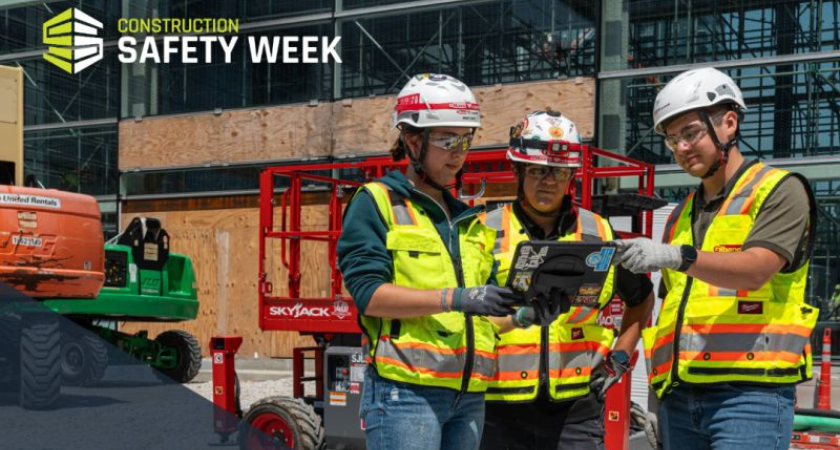
Held May 4 through May 8, the annual initiative brought together major contractors, subcontractors, labor teams and federal safety leaders under the banner “All In Together,” a campaign designed to reduce serious injuries and fatalities by focusing on the highest-risk construction activities.
This year’s framework moved beyond broad awareness messaging and concentrated on three operational pillars: recognizing dangerous conditions earlier, responding with stronger planning and controls, and reinforcing respect as a sitewide responsibility shared by executives, supervisors and craft professionals.
At the center of the week was a nationwide Safety Stand-Down on May 6 conducted in partnership with OSHA, aligning Construction Safety Week with the federal agency’s National Safety Stand-Down to Prevent Falls. Employers across the country paused work for fall prevention demonstrations, hazard identification exercises and toolbox talks, with participation spanning both megaprojects and regional jobsites.
Major event activations reflected the scale of industry involvement. In Washington, D.C., roughly 1,000 construction professionals gathered on the National Mall for one of the week’s flagship events and a formal OSHA alliance announcement. Turner Construction’s joint venture team hosted a project-wide event at Nashville’s New Nissan Stadium involving more than 2,000 workers. Hensel Phelps and Performance Contracting Inc. held a major safety partnership event at Montgomery Data Centers in Alabama, while APi Group organized programming in Chicago tied to broader workforce engagement.
Beyond headline gatherings, contractors nationwide used the week to conduct focused site trainings, executive safety briefings, mental health initiatives, equipment demonstrations and subcontractor engagement sessions. Large builders including Shawmut reported hundreds of coordinated events across dozens of locations, reinforcing the idea that safety culture now extends well beyond PPE checks and toolbox talks.
For owners and developers, the implications are increasingly strategic. Safety Week’s growing emphasis on pre-task planning, hazard recognition and leadership accountability reflects broader market expectations that builders deliver not only on schedule and budget, but with measurable safety maturity. Stronger safety cultures can directly affect insurance performance, labor stability, subcontractor reliability and owner risk exposure.
This year’s technical emphasis also reflects an industry challenge that remains unresolved: while recordable incident rates have generally improved, construction fatality rates have remained stubbornly elevated. Safety Week leaders used 2026 to sharpen focus on the disconnect between lower injury rates and persistent life-threatening hazards, particularly in high-energy environments such as falls, struck-by incidents, electrical exposure and heavy equipment operations.
For construction owners, developers and capital project leaders, Safety Week 2026 reinforced that contractor safety programs should be viewed as a core prequalification metric, not a secondary checklist item.
As projects grow more complex and labor markets remain tight, owners may increasingly favor contractors that demonstrate proactive safety systems, robust hazard planning and workforce engagement — especially on data centers, infrastructure and large commercial builds where risk concentration is high.
The bigger takeaway: Safety is becoming a leading indicator of operational discipline. Contractors that treat safety as culture rather than campaign may be better positioned to control costs, avoid disruptions and strengthen long-term competitiveness.
Source: www.constructionsafetyweek.com