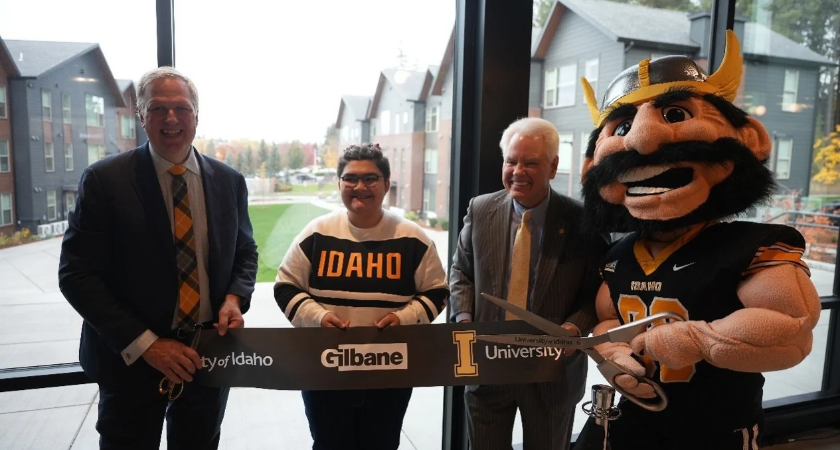
Expanding campus housing capacity is a key component of university infrastructure planning, particularly for institutions seeking to accommodate graduate students and student families. Gilbane Development, Rocky Mountain Companies and the University of Idaho have marked the completion of Vandal Village, a 451-bed residential development in Moscow, Idaho, as part of a broader $135 million effort to upgrade campus housing.
Located at 1010 Deakin Ave., Vandal Village encompasses approximately 200,000 square feet and 240 furnished apartments with two-, three- and four-bedroom layouts. The development provides 232 beds for graduate students and 219 beds for married and parenting students.
Apartments include full-size kitchens with dishwashers, in-unit washers and dryers, air conditioning and wireless internet. The community also includes a shared centre with spaces for studying, collaboration and social activities. The development is pet-friendly.
The mix of apartment sizes and shared facilities is designed to accommodate residents with different household needs, extending the university's housing options beyond conventional residence halls.
Gilbane Development and Rocky Mountain Companies served as the master development team. Lydig was the contractor, while Integrus and Design Collective provided architectural services.
The ribbon-cutting ceremony on Oct. 26 marked a milestone in a wider $135 million campus housing programme involving renovations and redevelopment at South Hill and Elmwood Apartments, Wallace Residence Center and Theophilus Residence Building.
The broader initiative combines new residential capacity with improvements to existing student housing facilities. Vandal Village represents one component of that investment in the university's residential infrastructure.
The project illustrates how higher education institutions are using dedicated residential developments to address the needs of graduate students and students with families. Its 451 beds provide housing capacity for groups whose accommodation requirements can differ from those of students living in traditional dormitories.
For developers, construction managers and institutional owners, the development also demonstrates the coordination involved in delivering specialised housing within an active university campus. The combination of private development partners, a contractor and architectural teams supported delivery within the university's broader redevelopment programme.
As universities plan campus improvements, projects such as Vandal Village connect residential capacity with long-term facilities planning and student support infrastructure.
Source: Gilbane.