Owners developing data centers, advanced manufacturing facilities, civic buildings and other power-intensive projects are facing a growing challenge: securing reliable electricity when utility infrastructure cannot keep pace with project schedules. Hensel Phelps is highlighting energy resilience strategies that can give project teams more control over power availability and help reduce the effects of grid constraints.
Rapid load growth, constrained transmission and distribution capacity, extended interconnection timelines and power disruptions are changing how owners approach energy infrastructure. Projects that depend on large amounts of electricity may face delays if utility service is not available when facilities are ready to operate.
Hensel Phelps' analysis emphasizes that energy resilience should be considered beyond conventional emergency backup power. Owners may need to evaluate how electricity will be generated, stored, managed and distributed throughout a facility's operating life.
Potential solutions include microgrids, renewable generation, battery energy storage, fuel cells, behind-the-meter generation and utility upgrades. The appropriate combination depends on a project's load requirements, schedule, site conditions, reliability needs and sustainability objectives.
For owners, the planning process begins with defining which loads are essential, how much power is required, when capacity must be available and how quickly critical systems need to respond to an interruption.
A confidential advanced technology infrastructure expansion program illustrates how alternative power strategies can be incorporated when utility capacity does not align with a project's schedule.
Utility power availability moved beyond the client's required capacity dates, prompting development of nearly 100 megawatts of behind-the-meter generation using modular solid-oxide fuel cells. The approach provided a scalable on-site power source and reduced reliance on the timing of public-grid expansion.
The change required coordination among the owner, technology provider, utilities, designers and trade partners. Electrical infrastructure, equipment procurement, site work, phased construction and commissioning all had to be aligned with the revised energy strategy.
The project also used defined construction zones and handoff milestones so fuel-cell installation could progress as portions of the site became available.
The example demonstrates how power infrastructure can become a core component of project scheduling rather than an issue addressed after building construction is substantially complete.
Energy resilience also has applications for public facilities that must remain operational during grid disruptions.
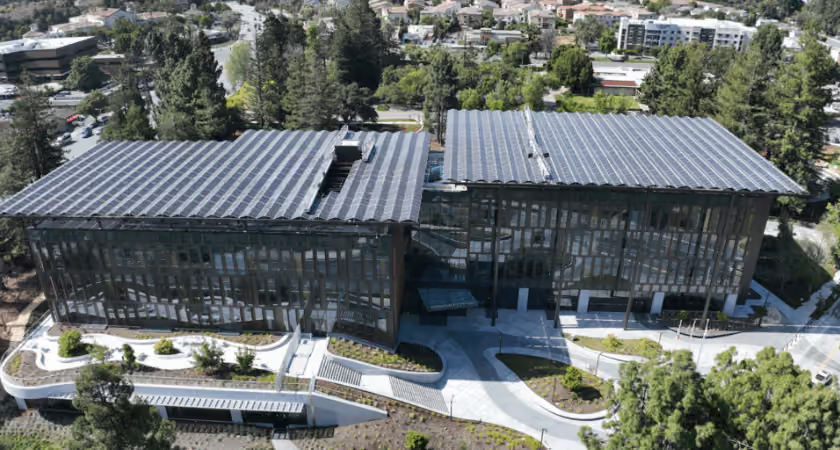
At Sunnyvale City Hall, a microgrid combines utility service with a 680-kilowatt photovoltaic array, a 250-kilowatt-hour battery energy storage system and emergency generation. The system is designed to support normal operations with on-site renewable power while maintaining essential municipal services when utility electricity is unavailable.
Implementation required coordination with the city, Pacific Gas and Electric and other project stakeholders. Interconnection requirements, inspections, temporary power and commissioning had to be managed while work occurred around an occupied civic campus.
The completed system contributes to the facility's net-zero energy performance and LEED Platinum certification while providing additional operational resilience.
Resilient energy systems can introduce significant procurement and coordination requirements. Switchgear, transformers, controls, generation equipment and other specialized components may have extended or uncertain lead times.
For construction teams, energy planning therefore needs to be connected to procurement schedules. Technical specifications, equipment decisions, factory testing, delivery requirements and installation sequencing can influence when a facility can be energized.
Commissioning is another critical consideration. A resilient power system involves multiple interconnected components, including utility service, generation, storage, emergency systems and controls. Testing individual components is not enough to confirm that the complete system will respond properly during an outage or transition between power sources.
Facility operators also need to be involved before turnover. Training and operational planning can help owners understand supported loads, system response, maintenance requirements and failure scenarios.
Grid availability is increasingly becoming a project-development consideration, particularly for facilities with large or rapidly growing electrical loads. Owners that wait until late design or construction stages to address power availability may face procurement, schedule and commissioning risks.
Early evaluation of on-site generation, storage and microgrid options can provide additional paths when conventional utility infrastructure cannot meet project requirements. It also allows construction teams to coordinate civil, structural, electrical, controls and commissioning work around the project's energy strategy.
As electricity demand grows across technology, manufacturing, infrastructure and other sectors, treating energy resilience as an early construction-planning decision could help owners improve schedule certainty and protect critical facility operations.
Source: Hensel Phelps.