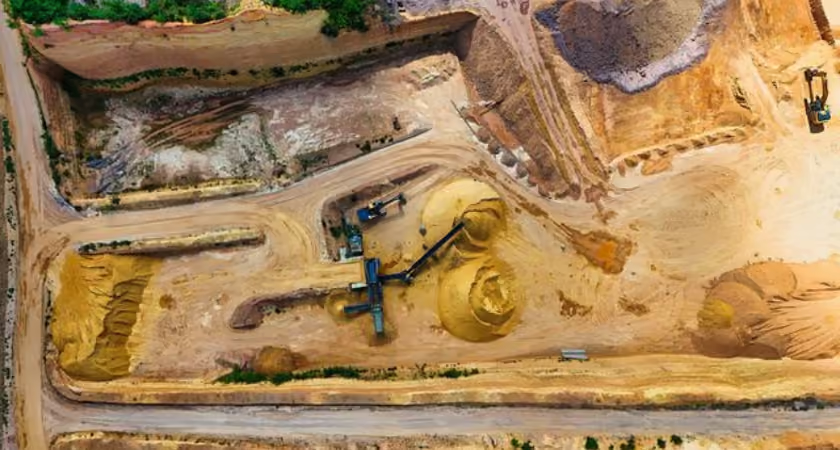
A federal court ruling allowing construction to continue at the Stibnite Gold Project in central Idaho marks an important development for the nation's critical minerals strategy and could have broader implications for construction, infrastructure, and resource development sectors.
The decision permits work to move forward on authorized project facilities while ongoing litigation over federal approvals continues. The project has drawn national attention because of its expected role in supplying antimony, a mineral considered essential for defense manufacturing, energy storage systems, electronics, and other industrial applications.
The mine received federal approval following an extensive environmental review process and is located within Idaho's Boise and Payette National Forests. Legal challenges seeking to stop early construction activities were rejected by the court, allowing project development to remain on schedule.
For contractors and project owners, the ruling underscores the growing importance of domestic resource development as federal policymakers seek to reduce dependence on overseas mineral supplies. Access to critical materials has become a major concern across sectors ranging from defense and energy to advanced manufacturing and infrastructure construction.
Project projections indicate substantial mineral production over the life of the operation, including antimony, gold, and silver. In addition to extraction activities, the development plan includes environmental remediation measures intended to address impacts from historical mining operations at the site.
Large-scale mining developments generate significant construction demand during site preparation, infrastructure installation, transportation improvements, utility work, and ongoing operational support. Projects of this scale typically create opportunities for contractors specializing in civil construction, earthmoving, environmental remediation, industrial facilities, and transportation infrastructure.
The continuation of construction activities also provides certainty for project stakeholders, subcontractors, suppliers, and local communities anticipating economic activity tied to the development.
As federal and state governments increasingly prioritize domestic manufacturing and supply chain resilience, critical mineral projects are expected to attract continued investment across multiple regions of the country.
The United States has expanded efforts in recent years to develop domestic sources of strategic minerals used in defense systems, renewable energy technologies, advanced electronics, and industrial manufacturing. Supply chain disruptions and geopolitical tensions have intensified interest in securing reliable domestic production capacity.
Mining projects capable of producing strategically important materials are increasingly viewed as part of a broader national infrastructure and industrial competitiveness strategy. As a result, permitting, environmental review, and legal challenges surrounding these projects are receiving heightened attention from both public and private sector stakeholders.
For owners, developers, and contractors involved in industrial and resource-based projects, the Idaho ruling highlights the potential for continued investment in domestic mining and critical materials infrastructure. Firms with expertise in heavy civil, industrial construction, environmental restoration, and transportation infrastructure may find growing opportunities as projects tied to supply chain security and domestic manufacturing move from planning into construction.
Source: Office Of Public Affairs, U.S. Department Of Justice.