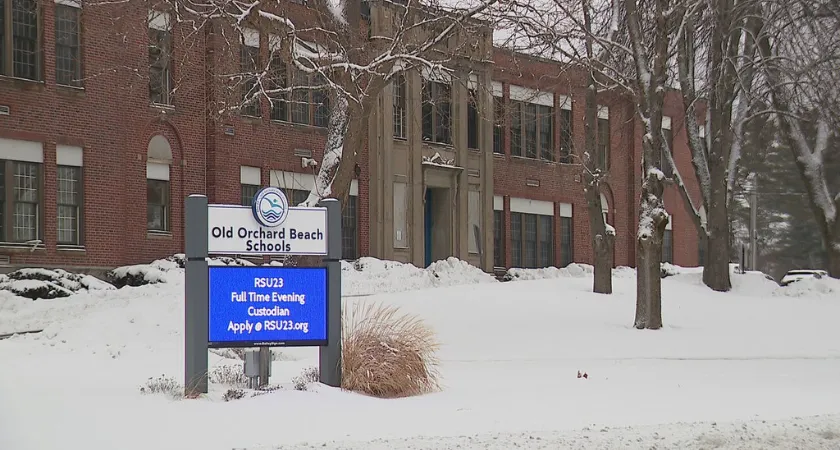
OLD ORCHARD BEACH, Maine — A state commission is proposing sweeping reforms to how Maine plans, funds and manages school construction, warning that aging facilities and rising costs threaten the state’s education infrastructure.
The Governor’s Commission on School Construction released its final report after more than a year of study, outlining what it describes as a long-term roadmap to address the crisis. The panel estimates it could cost roughly $11 billion over the next 20 years to repair or replace hundreds of aging school buildings across the state.
Maine has nearly 600 public schools, with an average building age of 54 years — a figure that underscores the scale of deferred maintenance and modernization needs.
For RSU 23 in Old Orchard Beach, the issue is urgent. The district is seeking to replace Loranger Memorial School, a 90-year-old building that no longer meets modern infrastructure or accessibility standards.
“We’re first in line right now for state funding,” RSU 23 Superintendent John Suttie said.
“The HVAC systems are ancient,” Suttie said. “Then there’s just learning spaces that are outdated, hallways that are outdated, stairwells that are not ADA compliant.”
Loranger currently ranks third on the state’s priority list for replacement, but only the top two projects received funding in the most recent round. Rising construction costs and limited bond capacity have slowed progress statewide.
Suttie said the backlog highlights a broader systemic challenge.
“It reflects a statewide problem, not just a local problem,” Suttie said.
Commission Chair Valerie Landry said Maine cannot address the crisis using the same strategies that created it.
“We need to look at this problem differently,” Landry said. “If we only drill down on the strategies that got us here, we’re not going to get out of this problem.”
The commission outlined four primary objectives:
Among its recommendations: tackling deferred maintenance earlier to prevent more expensive replacements later, encouraging consolidation where appropriate, creating prototype school designs to cut planning costs and developing a statewide facilities master plan.
“Would any one of these things help solve the problem? No,” Landry said. “But does every single one of them contribute to solving the problem? Yes.”
The report also highlights administrative hurdles that delay projects even after approval, including permitting, engineering studies, design requirements and property acquisition.
“There are so many things that have to happen that slow this process down,” Suttie said. “It’s anywhere between six and nine years between when a student actually walks into a building.”
.webp)
Even with process reforms, the commission acknowledged that financing remains the central obstacle. Without increasing the state’s debt service ceiling for school construction bonds — or identifying new revenue streams — Maine may struggle to keep pace with escalating costs.
Funding options outlined in the report include raising the bond cap, redirecting unused debt service capacity toward maintenance, establishing dedicated revenue sources and exploring public-private partnerships modeled in other states.
“These aren’t things that you’re going to flip a switch and make happen,” Landry said. “But if we begin now, we can chart a more sustainable path.”
One of the report’s most significant proposals is the creation of a quasi-independent Intergovernmental Office of School Infrastructure to coordinate planning, data analysis and funding strategies between state and local governments. Establishing the office would require legislative approval.
In the near term, the commission is urging state leaders to form a working group to draft legislation and implementation details — a step it says is critical if Maine hopes to address decades of deferred investment before costs climb even higher.
Originally reported by Dan Lampariello,CBS13I-Team in WGME.