Steel fabrication increasingly depends on accurate digital information before material reaches the shop floor. For Mid-City Steel, 3D modeling provides a coordinated environment for developing structural steel details, reviewing connections and transferring project information into fabrication and production processes.
The La Crosse, Wisconsin-based fabricator uses Tekla Structures and Tekla PowerFab to connect detailing with fabrication management. The workflow supports model development, clash detection, constructability review, revision control, automated fabrication and production tracking.
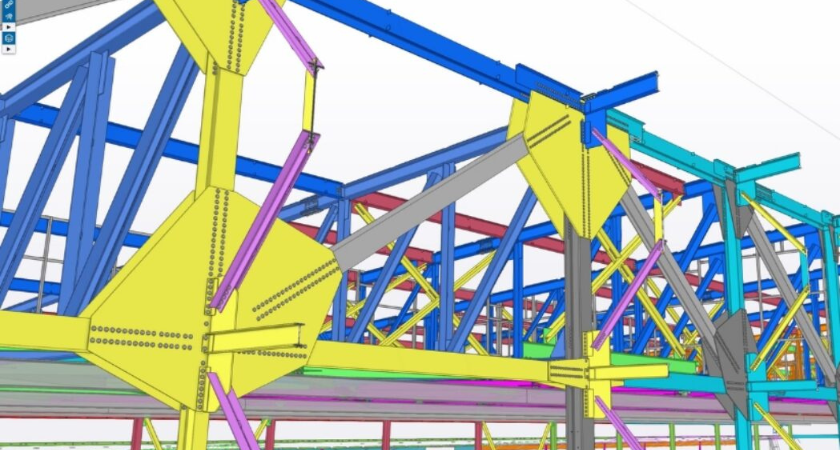
A fabrication model contains considerably more information than a visual representation of a building. Members, plates, connections, bolts, welds, stiffeners, holes, finishes and piece marks can be represented within a shared three-dimensional environment.
This allows detailers and project teams to review steel assemblies in context rather than relying exclusively on individual plans, elevations and sections.
The approach can also reduce repeated manual data entry. Drawings, reports and fabrication information can be generated from coordinated model data, helping teams maintain consistency as projects move through detailing and production.
Modeling does not replace engineering review or quality control. Detailers, project managers, engineers, fabricators and quality personnel remain responsible for interpreting requirements, resolving issues and verifying released work.
Coordination is a major application of 3D modeling. Steel members and connections can be reviewed against mechanical systems, equipment, concrete, architectural components and other project elements.
Potential conflicts can include direct overlaps as well as clearance problems. Connection access, bolt installation, weld access, maintenance areas and space for other trades can all affect whether a modeled condition is practical to construct.
Constructability reviews extend beyond clash detection. Fabricators can evaluate machine capacity, assembly dimensions, weld access, material handling, shipping limitations and erection requirements before steel is produced.
The model also allows teams to review connection geometry and fit-up digitally. Bolt patterns, plates, stiffeners, copes and member orientations can be examined as complete assemblies, helping identify conditions that may be difficult to recognize in separate two-dimensional views.
Mid-City Steel's model-based workflow extends from detailing into fabrication. Digital information can support saw and drill operations, plate cutting, robotic processing, welding and other automated production activities.
Using model-driven information can reduce manual layout and repeated measurements while improving consistency across fabricated components. Piece marks and associated data can also connect shop drawings with purchasing, production, quality control, staging and shipping.
Tekla PowerFab provides fabrication management capabilities across estimating, purchasing, inventory, production and shipping workflows. When connected with detailing information, the system provides greater visibility into the status of steel packages and individual pieces.
Revision control is another important part of the process. Engineering changes, equipment updates and field conditions can affect steel after detailing has begun. Identifying affected members and associated fabrication information helps project teams determine whether changes impact purchasing, production, coating or shipment.
Model-based steel fabrication can move more coordination and constructability work into the digital project environment before steel reaches the jobsite. For complex projects, that can help teams identify connection conflicts, review installation requirements and manage changes earlier in the process.
The technology does not eliminate the need for experienced detailers, engineers, fabricators or inspectors. Instead, it gives those teams a shared source of project information that can connect design development with fabrication and field installation.
For owners, general contractors and steel erectors, better coordination before fabrication can support more predictable material production, delivery and installation while reducing avoidable field conflicts.
Source: Mid-City Steel.