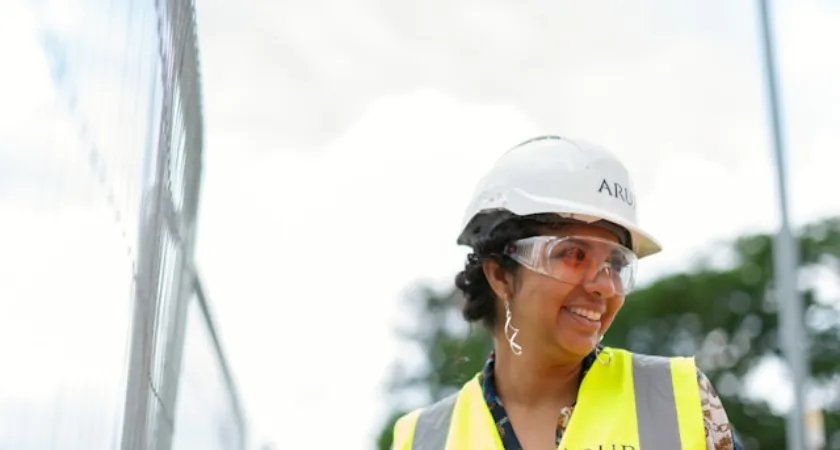
Construction has long been a male-dominated field. According to recently released data from the U.S. Census Bureau, only 11.7% of payroll employees in the construction industry are women. However, a shift is underway. In recent years, the Department of Labor’s Women in Apprenticeship and Nontraditional Occupations (WANTO) grant program has allocated millions of dollars to bolster women’s participation in industries like construction. And with the construction industry facing a massive worker shortage — estimated at 349,000 workers — recruiting women into construction roles has become a necessity for sustaining growth and meeting demand.
.webp)
The share of women in construction has steadily increased over the past several years. While women remain underrepresented in the workforce, the data reveals a gradual yet consistent upward trend in female employment within the construction sector.
Prior to 2016, women comprised approximately 9% of the construction workforce. That figure remained relatively steady for more than a decade, fluctuating between 8.9% and 9.5% from 2003 to 2015. Since 2016, however, the percentage has climbed nearly every year — reaching 11.1% in 2022 and rising further to 11.7% by 2024.
Nationwide, more than 1.3 million women now work in construction, compared to over 10 million men. Still, most women in the industry hold office and administrative roles. According to the U.S. Bureau of Labor Statistics, women account for 81.4% of office and administrative jobs within construction.
By contrast, female representation remains low in field-based roles. Women make up just 4.1% of transportation jobs and 4.0% of construction and extraction positions. The numbers are even lower in maintenance, repair, and production roles, where women represent between 3% and 4% of workers.
Women in construction tend to earn more than women working in other industries. The median annual wage for full-time female construction workers is $57,725 — higher than the $55,817 median for women across all sectors.
Interestingly, men in construction earn less than their counterparts in other industries. Male construction workers have a median annual wage of $60,561, compared to $67,260 for men nationwide.
The gender pay gap is also narrower in construction. While the overall national wage gap stands at roughly 17%, the gap within construction is just 4.7%.
Female participation in construction varies significantly by state and metro area. Delaware leads the nation, with women making up 14.2% of its construction workforce, followed by Florida at 13.5%. States such as Alaska, Hawaii, Washington, and Oregon also report above-average female representation.
At the metro level, Jacksonville, Florida, ranks highest, with women accounting for 17.4% of construction workers, followed by Orlando at 15.7%. Meanwhile, some Texas and Northeastern metro areas report female employment shares below 9%, with McAllen, Texas, at the bottom at 7.5%.
.webp)
In Oklahoma, women make up 10.7% of the construction workforce — slightly below the national average of 11.7%. The state employs 14,459 women in construction compared to 120,183 men.
Median earnings for full-time construction workers in Oklahoma stand at $51,019, below the national median of $60,419.
The findings come from an analysis conducted by Construction Coverage using federal labor and census data. The report highlights steady progress in diversifying the construction workforce, though women remain significantly underrepresented in field-based roles across the country.
Originally reported by Construction Coverage, CityNewsOKC in City News OKC.