Robotics is rapidly reshaping architectural design and construction, introducing new methods of fabrication, structural experimentation and material innovation. From robotic arms and drones to advanced 3D printing systems, emerging technologies are enabling architects and researchers to rethink how buildings are designed and constructed.
Across the architecture and construction sectors, robotic tools are being used to perform complex tasks ranging from masonry and fabrication to demolition and structural assembly. These developments are not only improving efficiency but also opening new possibilities for experimentation with materials and digital design processes.
As the use of robotics expands, industry experts are increasingly examining how technology can enhance architectural creativity rather than simply automating traditional construction processes. This raises a broader question for the industry: whether architecture should adapt to emerging technologies or whether technologies should evolve to support architectural goals.
Robotic technologies are often associated with improving precision, efficiency and productivity in construction projects. According to the International Federation of Robotics, an industrial robot is defined as “an automatically controlled, reprogrammable, multipurpose manipulator, programmable in three or more axes, which can be either fixed in place or fixed to a mobile platform for use in automation applications in an industrial environment.”
These machines can be programmed to perform highly repetitive or complex tasks with accuracy that is difficult to achieve through traditional manual construction methods.
In the building sector, robots are increasingly used for operations such as bricklaying, paving, welding, cutting and fabrication. They can also perform work in hazardous environments, including confined spaces or demolition zones, improving worker safety.
“Robots and humans will work together,” said Alexander Dubor, highlighting the growing importance of collaboration between technology and human expertise in shaping the future of construction.
Some architectural projects are now being designed specifically to integrate robotic fabrication systems.
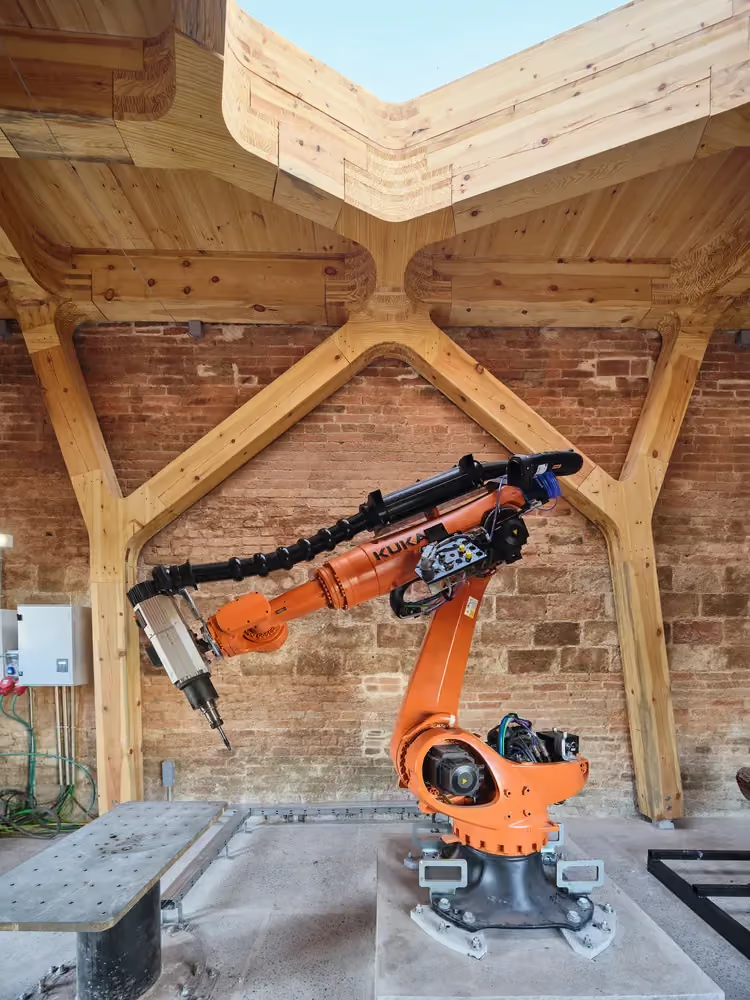
One example is the CORA Installation, developed by students at the Institute for Advanced Architecture of Catalonia. The project created a dedicated laboratory space designed to house and operate a KUKA industrial robotic arm, a tool capable of performing precision milling, cutting and fabrication.
Often referred to as the “Cathedral of Robotic Artisans,” the installation was designed to support both robotic manufacturing and human collaboration. The structure includes specialized infrastructure and services needed to support advanced robotic fabrication processes.
Projects like this highlight how architectural design can evolve alongside new construction technologies.
Robotic fabrication is also enabling architects to experiment with new materials and bio-based building systems.
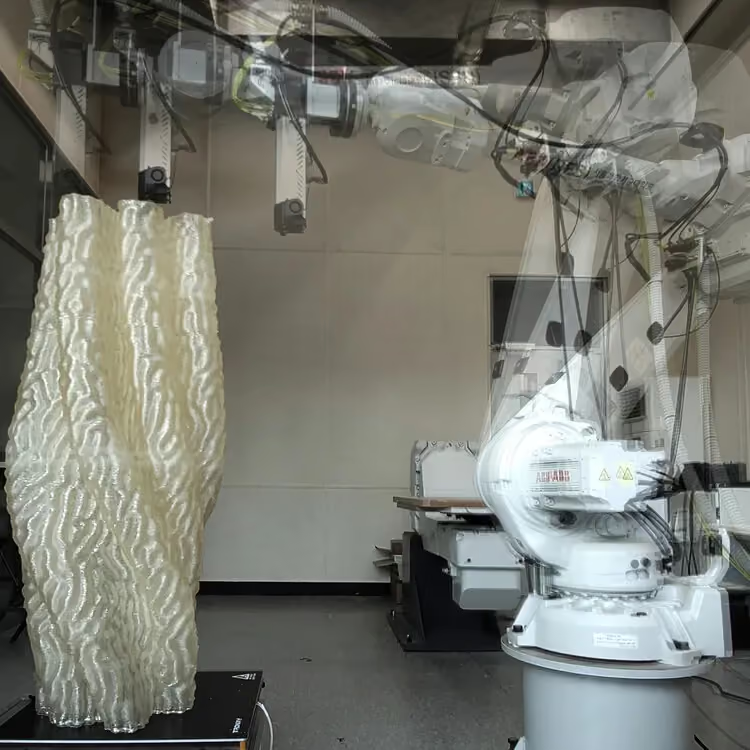
For example, the Moss Columns project developed by Yong Ju Lee Architecture explores the integration of living organisms into structural design. Using robotic 3D printing systems, the project creates vertical structures that incorporate moss as part of the architectural form.
The design process uses computational modeling and a fabrication method known as Fused Granulate Fabrication (FGF). This process uses an industrial robotic arm equipped with a specialized extruder to deposit materials layer by layer, producing complex structural geometries.
Another experimental approach involves mycelium, the root-like structure of fungi, which can be used as a sustainable building material. The Mycelial Hut Pavilion demonstrates how robotic fabrication and biological growth systems can be combined to produce environmentally responsive architectural structures.
Researchers say these experiments demonstrate how architecture can merge natural systems with digital fabrication technologies.
Robotic systems are also being used to construct full-scale architectural structures using traditional materials.
At the ETH Zurich, researchers from Gramazio Kohler Research developed the Clay Rotunda, a cylindrical structure built from more than 30,000 clay bricks assembled by a mobile robotic system.
The structure forms part of the SE MusicLab auditorium inside the Gurten Brewery in Bern. The project used computational modeling to determine structural geometry, material behavior and the robotic construction sequence.
In Japan, Obayashi Corporation developed the 3dpod Pavilion, a 3D-printed concrete structure designed to test earthquake-resistant architectural systems. The structure was printed using specialized mortar and reinforced with high-strength fiber concrete.
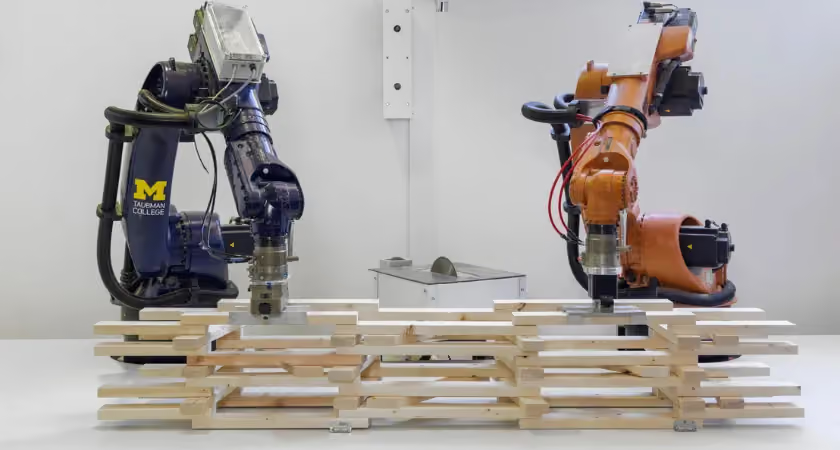
Robotic fabrication has also been explored in wood construction. Researchers from the University of Michigan Taubman College of Architecture and Urban Planning developed a robotically fabricated wooden pavilion that uses custom algorithms and robotic arms to assemble precisely engineered components.
These experiments show how digital fabrication tools can reduce material waste, improve structural precision and enable complex geometries that would be difficult to construct using conventional techniques.
Despite rapid advances in robotics and artificial intelligence, experts say these technologies are unlikely to replace architects or traditional construction methods entirely.
Instead, robotic fabrication is expected to complement human creativity by enabling new design possibilities and improving construction workflows.
The integration of robotics with architecture also supports broader industry goals such as sustainability, resource efficiency and interdisciplinary collaboration.
As researchers continue to explore the relationship between architecture, technology and ecology, robotics is expected to play an increasingly important role in shaping the built environment.
Rather than replacing human expertise, emerging technologies are helping architects push the boundaries of design and construction, opening new opportunities to rethink how buildings are conceived, fabricated and inhabited in an evolving technological landscape.
Originally reported by Agustina Iñiguez in Arch Daily.