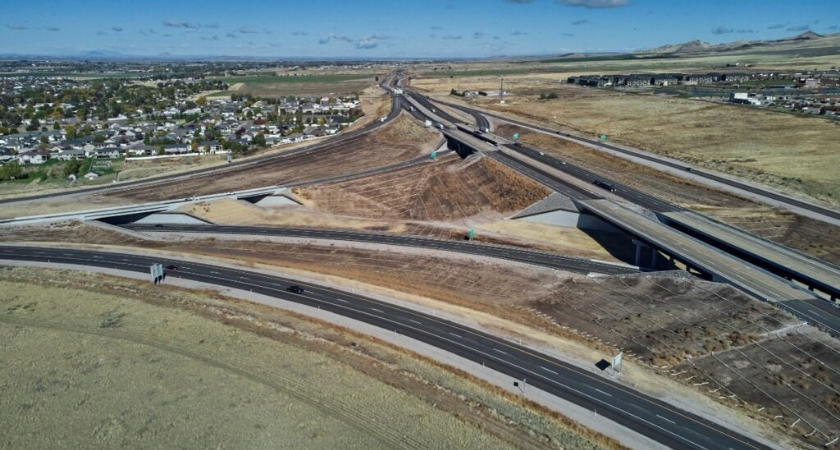
Sundt is highlighting progress on two major Idaho transportation projects: the I-86 and I-15 System Interchange, known as the “Flying Y,” in Pocatello, and the I-15 Widening from Northgate to South Hall.
The projects are addressing aging infrastructure, congestion and growing transportation demands along routes used heavily by local motorists, commercial vehicles and travelers heading toward Yellowstone and other regional destinations.
The I-86 and I-15 System Interchange was originally built in the mid-1960s and had become increasingly challenged by congestion and safety concerns.
Sundt's work included eight new bridges, collector-distributor lanes, retaining walls, ramps and highway realignments. The project also required substantial earthwork.
Working with ITD, Sundt developed a phasing strategy that maximized the reuse of excavated material. The approach reduced the need to import material while also limiting material that had to be transported off-site.
The Flying Y project was completed in fall 2025.
Sundt is applying another construction innovation on the I-15 widening between Northgate and South Hall.
The 3.9-mile project is expanding the highway to three lanes in each direction. Instead of traditionally hand-forming the concrete median barrier, crews are using slip-form techniques that allow continuous concrete placement.
The method reduces labor and equipment requirements while supporting faster production. Combined with an updated phasing plan, the approach has shortened the expected construction schedule by six months.
The project is scheduled for completion by the end of 2026.
Sundt also carried employee-owners from the completed Flying Y project into the I-15 widening effort. Maintaining continuity within the project team has helped the contractor build on existing relationships with ITD and other stakeholders.
The company said this continuity has supported communication, faster responses to challenges and a smoother transition between projects.
Idaho's transportation network is facing growing demands from residents, freight traffic and regional travelers. Sundt's work demonstrates how construction innovation and early collaboration can help agencies modernize aging infrastructure while controlling costs and schedules.
Material reuse can reduce waste and hauling requirements, while slip-form construction can accelerate highway work and reduce resource demands. Together, these strategies can help deliver safer, higher-capacity transportation infrastructure while minimizing disruption to motorists.
Source: Sundt.