Turner Construction Company used a preconstruction-driven installation strategy to place six escalators through the roof of the new Consolidated Rental Car Facility at Gerald R. Ford International Airport in Grand Rapids, Michigan, completing the lifts in a single day without affecting the project schedule.
The approach demonstrates how early coordination among general contractors, structural engineers, equipment suppliers, roofing contractors and specialty trades can reduce logistical complexity on projects with constrained installation conditions.
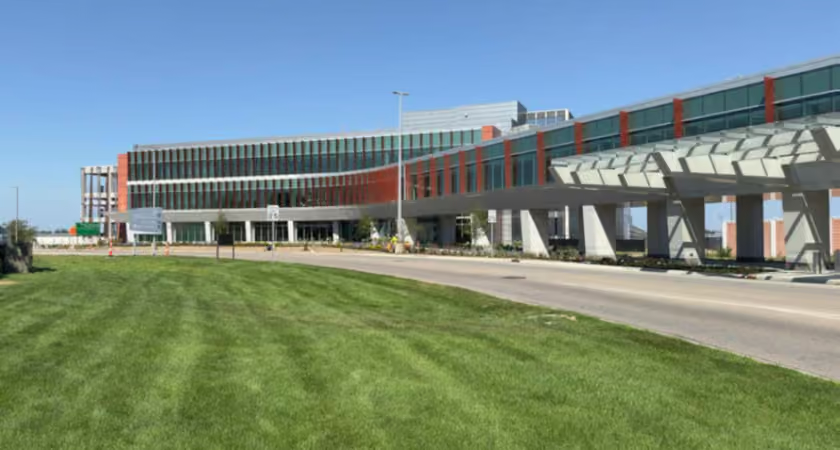
The ConRAC facility consolidates rental car operations at Gerald R. Ford International Airport into a single complex consisting of a four-story ready/return parking garage with an integrated customer service building, a three-story quick turnaround facility and a climate-controlled skywalk connecting to the terminal.
Turner’s project team determined early that installing the escalators through temporary roof openings would provide a more efficient alternative to moving the equipment through the completed building.
Transporting and lifting the escalators internally would have required additional evaluation of floor-loading conditions, specialized hoisting equipment and potentially additional structural steel. The roof-lift strategy allowed the equipment to be lowered directly into its final locations, beginning with the lowest units and progressing upward.
The strategy required coordination of structural steel, decking and roofing work around the temporary openings. The team also reviewed escalator shop drawings against the structural design and resolved differences before the scheduled installation.
The escalators were delivered in three sections per unit and assembled on site. The arrangement reduced transportation and handling challenges while allowing multiple units to be prepared concurrently.
Before the lifts, the team used laser measurements to verify the roof openings and coordinated required framing modifications with the structural engineer and steel contractor.
The crane position, rigging configuration, lift sequence, airport notifications and safety requirements were established in advance. Because the crane remained below the previously permitted tower-crane height, the operation could proceed within established aviation constraints.
Airport officials were notified of the crane location, operating duration, visibility requirements and potential effects on air traffic control.
The six escalators were then lowered through the roof and placed directly into their final positions in one day. After installation, the equipment was protected with heavy-duty plastic while structural steel, decking and roofing work progressed.
Turner coordinated the roofing and steel trades in advance so the building could be enclosed quickly and the escalators protected from weather exposure.
The installation was completed without delaying the project schedule. While the project team did not quantify the precise savings, it identified the roof-lift strategy as a cost-saving measure for the owner and an efficient response to the project's design and site constraints.
The project also illustrates the importance of evaluating complex equipment installation during preconstruction rather than waiting until structural work is substantially complete. Early decisions regarding equipment dimensions, crane access, temporary openings and trade sequencing can reduce field conflicts and limit the need for costly temporary systems.
For construction owners and developers, the case highlights the potential value of installation planning as part of project delivery strategy. Coordinating specialty equipment with structural, roofing and logistics requirements can help reduce schedule exposure on facilities where access is restricted.
For contractors, the project reinforces the need for detailed lift planning, field verification and communication among engineering and trade partners. Airport projects add another layer of coordination because crane operations and construction activities must be planned around aviation requirements.
The Turner case study also underscores a broader construction trend toward greater preconstruction coordination for complex projects. As buildings incorporate larger prefabricated components, specialized equipment and increasingly constrained sites, installation sequencing can become a significant factor in controlling cost, safety and schedule performance.
Source: Turner Construction.