With guidance from Assistant Professor Paul Mayencourt and the UC Berkeley Wood Lab, Humboldt County’s Mad River Mass Timber, or MRMT, is pioneering the commercial manufacture of dowel-laminated timber, or DLT, in California.
.webp)
As the first vertically integrated producer of mass timber in the state, MRMT transforms forest waste into construction-ready building panels. The company’s approach signals a shift in how California sources materials for large-scale development — replacing carbon-intensive steel and concrete with engineered wood products designed to store carbon rather than emit it.
Unlike traditional lumber, DLT panels can be manufactured from a wide variety of wood species. Smaller-diameter trees or weaker species such as red fir, hemlock and Ponderosa pine — often removed during forest thinning operations — can be combined to create structurally strong panels. Fire-damaged timber, which previously lacked commercial value, can also be repurposed.
The commercialization of DLT promises to create a new sustainable manufacturing sector in California, benefiting forests, the climate and regional economies. The product can also be used for rapid, efficient construction, offering potential relief for California’s housing shortage.
“It’s essential that we reimagine how we build,” says Mayencourt, who holds degrees in architecture and engineering from MIT and the Swiss Federal Institute of Technology in Zurich. He has collaborated with Wood Lab researchers on projects exploring underutilized California wood species, including DLT.
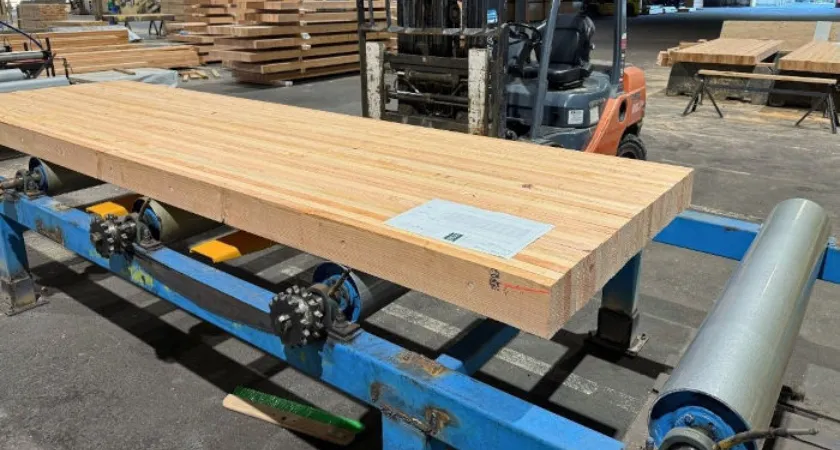
DLT is part of the broader mass timber category — engineered wood panels prefabricated for construction. Unlike steel and concrete, mass timber is renewable and stores carbon for the life of a building. Because DLT uses wooden dowels instead of chemical adhesives, it is fully recyclable and avoids petroleum-based bonding agents used in other engineered wood products.
The environmental stakes are significant. Roughly 40% of global CO2 emissions are tied to building construction and operations. Research published in Building and Environment found that mass timber buildings reduced global warming potential by 39% to 51% compared to reinforced concrete structures and by 28% to 34% compared to structural steel buildings.
Until recently, most mass timber used in California projects was imported from Washington state or Canada, adding transportation emissions that offset some environmental gains. By producing DLT locally from California forests, MRMT reduces long-haul trucking and strengthens in-state supply chains.
“When I learned about mass timber in college, I knew it was something I wanted to pursue,” says fifth-generation sawmill operator and MRMT President George Schmidbauer. “The market was gaining momentum and there was increasing demand for locally sourced materials to address California’s wildfire and forest health issues.”
Schmidbauer initially explored cross-laminated timber (CLT) production but found the up-front capital investment too high and incompatible with California’s existing lumber supply. Seeking a more cost-effective solution, he connected with the Berkeley Wood Lab after seeing Mayencourt’s small-scale DLT fabrication experiments.
“Initially, I acted in a consulting capacity, working to help develop the DLT process,” says Mayencourt. “George and I would have weekly calls, sharing ideas and troubleshooting. With a grant received by the Joint Institute for Wood Products Innovation, my Berkeley Wood Lab research associate Jitske Swagemakers and I were designing projects using DLT in the Tahoe region, and George, with his knowledge of the timber industry and supply chain, was figuring out the manufacturing side in Humboldt.”
To scale production, MRMT designed and built its own DLT fabrication machinery using standard industrial components. The company now produces prefabricated floors, roofs, walls and beams suitable for residential, commercial and institutional projects. Mayencourt also helped draft the design guide for MRMT’s DLT products, aligning them with California building codes to streamline adoption.
This collaboration reflects a broader trend in California’s construction sector, where universities are partnering with private industry to accelerate decarbonization strategies while maintaining economic competitiveness.
MRMT sources wood from national forests and tribal lands engaged in wildfire mitigation and forest restoration efforts. By removing low-value biomass that might otherwise fuel severe wildfires, the company supports forest health while generating revenue from materials traditionally considered waste.
“With DLT, we can put lower-value wood into panels and engineer around that species’ reduced structural capacity,” says Schmidbauer. “This means we can connect forest restoration and wildfire mitigation to the low-carbon construction economy in more ways than previously possible.”
California’s wildfire seasons have intensified in recent years, placing new urgency on sustainable forest management. By creating a market for smaller trees and fire-damaged lumber, MRMT’s DLT production makes thinning operations more economically viable.
Beyond environmental benefits, MRMT and Berkeley researchers are applying DLT to address housing affordability. Drawing on Schmidbauer’s experience in affordable housing development and the architectural expertise of Mayencourt’s team, they are developing prefabricated DLT kits for multifamily housing.
Prefabrication can shorten construction timelines, reduce labor costs and improve quality control — factors that are particularly important in affordable housing development.
As MRMT expands, the company is expected to create manufacturing and forestry jobs in Humboldt County, strengthening rural economies historically dependent on timber.
“The entire process is optimized for local economic and environmental benefit,” says Schmidbauer.
“Seeing MRMT scale up the manufacture of DLT is exciting.” say Mayencourt. “With one relatively low-tech innovation, we can tackle forest health, wildfire risk, the housing crisis, and struggling rural economies. We can start to fulfill our commitment to reduce greenhouse gas emissions for the future of our planet.”
.webp)
As California advances ambitious climate goals, including carbon neutrality targets, mass timber is emerging as a viable tool in reducing embodied carbon in buildings.
State policymakers have increasingly encouraged sustainable building materials through updated codes and incentives. If DLT adoption accelerates, California could become a national leader in mass timber innovation — pairing climate action with workforce development.
With early projects already underway and additional partnerships in development, MRMT’s model demonstrates how research institutions and rural manufacturers can jointly reshape an industry long dominated by high-carbon materials.
By linking forest stewardship, affordable housing and climate-conscious construction, UC Berkeley’s research and MRMT’s manufacturing strategy are redefining what sustainable building looks like in California.
Originally reported by Lake County News Reports in Lake County News.