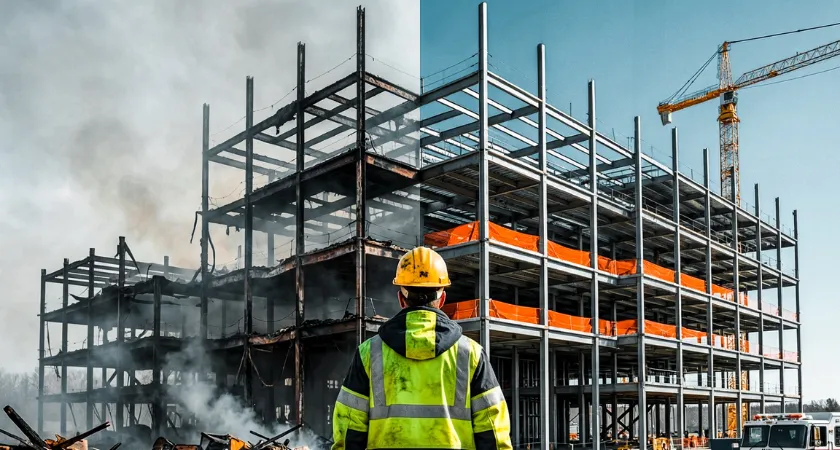
Ramtech has relaunched its flagship construction safety whitepaper, shining a spotlight on persistent gaps in fire protection practices across U.S. jobsites and previewing key updates expected in the 2026 revision of NFPA 241.
Titled “Closing the Gaps in Construction Fire Safety,” the updated report builds on the company’s earlier research and incorporates insights from industry partners including Barton Malow and Space Age Electronics.
Inconsistent Code Adoption Raises Safety Concerns
The report underscores a major industry challenge: inconsistent adoption and enforcement of NFPA 241 across different states and jurisdictions. According to the findings, many projects continue to rely on outdated code versions or follow only minimum compliance requirements—leaving significant safety gaps.
James Pecz, Ramtech’s North America lead and a member of the NFPA 72/241 Temporary Fire Alarm Task Group, emphasized the risks tied to this fragmented approach:
“Across the U.S., adoption of NFPA 241 is still highly inconsistent. My work on the NFPA 72/241 Temporary Fire Alarm Task Group has highlighted how reliance on older editions or minimum-code compliance leaves sites exposed, especially as projects become larger and more complex. Wireless detection and notification systems can bridge these gaps, helping contractors meet best-practice standards while protecting people, assets, and schedules.”
The whitepaper highlights that as construction projects scale in size and complexity—particularly with high-rise and mixed-use developments—the limitations of traditional fire safety approaches become more pronounced.
2026 Code Updates and Technology Integration
A key focus of the report is the anticipated 2026 update to NFPA 241, which is expected to introduce more practical and modernized safety provisions.
Among the expected changes:
- Enhanced guidance for mass timber construction
- Stricter site security requirements
- Clearer definition of Fire Prevention Program Manager (FPPM) responsibilities
- Stronger alignment with other fire safety standards, including NFPA and international codes
The report positions these updates as a step toward closing long-standing safety gaps, particularly during early construction phases when permanent fire protection systems are not yet operational.
Real-World Challenges on Complex Jobsites
Industry leaders contributing to the report emphasized the real-world difficulties of implementing fire safety protocols on large, multi-phase construction sites.
Kyle Jarvenpaa of Space Age Electronics highlighted the operational realities:
“Projects with hundreds of workers across dozens of floors present unique challenges. The real test isn’t just knowing the code – it’s making sure every worker hears the alarm, every floor is cleared, and safety teams have real-time visibility.
Coordinated wireless detection and notification systems turn complex safety plans into action, giving workers confidence they’ll be alerted immediately in an emergency, while helping teams respond faster and keep projects moving efficiently.”
The whitepaper notes that Authorities Having Jurisdiction (AHJs) are increasingly recognizing wireless systems as a viable way to maintain compliance and safety before permanent infrastructure is installed.
Case Studies Demonstrate Scalable Solutions
The report includes detailed case studies showcasing how wireless fire detection systems are being deployed on large-scale developments.
On the $1 billion Hudson’s Detroit development, safety teams implemented coordinated alarm systems to ensure consistent communication across the site.
Anna Kahl described the importance of reliable systems:
“On a project of this size, evacuation planning can’t rely on assumptions. Noise, height, changing access routes, and limited visibility are the norm, not the exception. A coordinated alarm system that reached all workers at the same time was vital – it kept our team safe and gave us confidence in every drill.”
Another example cited in the report details the use of more than 350 wireless devices on a $1.3 billion resort project in California, demonstrating how temporary systems can deliver protection comparable to permanent installations.
Industry Expansion and Strategic Growth
The whitepaper release coincides with Ramtech’s continued expansion in North America, including the opening of a new office in Charlotte.
Pecz added:
“Working with our construction partners across the U.S., we have witnessed first-hand the complexity of the challenges faced by building owners and fire prevention program managers (FPPMs). Four years since we compiled our first white paper on the subject, we felt the time was right to revisit and unpack what has changed and what still needs attention.
Having recently opened our North Carolina address, we are now more equipped than ever to support the U.S. construction sector and tackle the biggest challenges of site safety. Our aim has and always will be to create positive change through our simple, fast and secure, wireless solutions. We hope this whitepaper will once again raise the importance of technology in preventing fire and medical emergencies within the complex environmental conditions of construction sites.”
The renewed focus on construction fire safety comes at a time when:
- Projects are becoming larger and more vertically complex
- Labor forces are more dynamic and distributed across sites
- Temporary risks during construction phases are gaining greater regulatory attention
Wireless safety systems, as highlighted in the report, are increasingly viewed as a bridge between traditional compliance frameworks and modern construction realities—offering flexibility, speed of deployment, and real-time monitoring capabilities.
Outlook
As the 2026 revision of NFPA 241 approaches, the industry is likely to see increased emphasis on proactive safety planning and technology integration.
Ramtech’s updated whitepaper positions itself as both a diagnostic tool and a roadmap—encouraging contractors, developers, and regulators to rethink how fire safety is managed on evolving construction sites.
Originally reported by Ram Tech.