A new $610 million federal construction project in South Texas is underscoring how national infrastructure priorities are expanding beyond traditional transportation and defense assets into specialized facilities focused on food system protection and biological risk management.
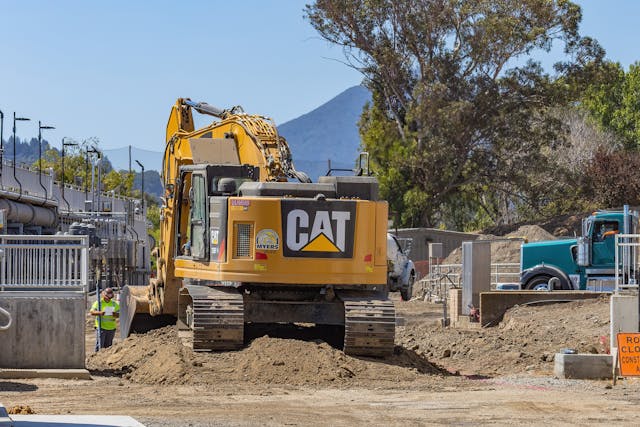
The project, led by Mortenson at Moore Air Base in Edinburg, Texas, involves the development of a sterile insect production facility designed to help prevent the spread of the New World Screwworm, a pest capable of severely impacting livestock production and agricultural supply stability.
Delivered under a design-build contract for the U.S. Army Corps of Engineers in coordination with the U.S. Department of Agriculture, the project reflects a growing federal emphasis on infrastructure tied directly to national resilience objectives.
Unlike conventional industrial or agricultural facilities, the Texas buildout incorporates specialized biosafety and containment environments designed for continuous operation under tightly controlled conditions.
The facility will operate as a sterile insect production center with output initially targeting approximately 100 million insects per week, scaling to roughly 300 million at full capacity. Its design includes redundant mechanical, electrical, and environmental systems intended to support uninterrupted operations.
These requirements place the project closer to pharmaceutical-grade or laboratory-level construction standards than traditional agricultural infrastructure, increasing demands on design coordination, commissioning, and long-term systems reliability.
The use of a design-build structure reflects a continued shift in federal procurement strategy, particularly for technically complex facilities where operational performance is directly tied to national economic or security outcomes.
Early contractor involvement allows design and construction teams to align on system integration, containment requirements, and operational workflows before full-scale construction begins. For large-scale biosafety projects, this approach is increasingly viewed as a way to reduce schedule risk and improve long-term facility performance.
The Texas facility highlights a broader trend in federal capital investment: infrastructure is increasingly being shaped around resilience rather than purely transportation, logistics, or capacity expansion goals.
Facilities tied to food security, disease prevention, and supply chain protection are becoming a more visible category within public works spending. These projects often require highly specialized delivery teams with experience in controlled environments, redundant systems, and mission-critical operational design.
For contractors, this shift represents a growing pipeline of technically advanced work that blends elements of industrial processing, life sciences construction, and federal infrastructure delivery.
The complexity of the Moore Air Base project reflects a broader convergence across construction sectors. Features such as biosafety containment, continuous operation requirements, and redundant infrastructure systems are increasingly common in data centers, healthcare facilities, semiconductor manufacturing, and advanced industrial plants.
This convergence is reshaping contractor capability requirements, favoring firms with experience in multi-disciplinary coordination and high-reliability systems integration.
In parallel with expanding federal investment in resilience infrastructure, private-sector contractors continue to pursue high-performance building standards across industrial and mission-critical markets.
For example, DPR Construction recently highlighted advancements in project delivery and construction quality standards in its industry communications. DPR earns gold seal
For construction owners and developers, the Moore Air Base project reinforces a structural shift in infrastructure demand toward facilities defined by operational continuity, containment, and national strategic importance.
Owners pursuing complex facilities may increasingly encounter expectations for integrated delivery models, early-stage collaboration, and system redundancy built into both design and construction phases.
As federal and private capital continues to prioritize resilience-driven infrastructure, contractors capable of executing technically specialized, mission-critical projects are likely to see expanded opportunities across agriculture, life sciences, defense-adjacent, and advanced industrial sectors.
Originally reported by Mortenson.