A newly opened affordable housing community in San Francisco is drawing attention not only for expanding housing options for seniors but also for demonstrating a construction delivery approach aimed at controlling costs and accelerating project timelines.
The development at 1633 Valencia Street has brought 145 permanent supportive housing units to the city's Mission District for residents aged 55 and older. The project was developed by Mercy Housing California, with design services provided by David Baker Architects and financial support from the San Francisco Housing Accelerator Fund.
.avif)
For construction industry stakeholders, the project serves as an example of how integrated project delivery methods can address persistent challenges facing affordable housing developments, including rising construction costs, labor pressures, and complex funding structures.
Cahill, which served as design-builder on the project, implemented an early-stage collaboration strategy that brought architects, specialty contractors, and key trade partners into the planning process before design completion. The approach focused on aligning design decisions with budget and schedule objectives from the beginning of the project.
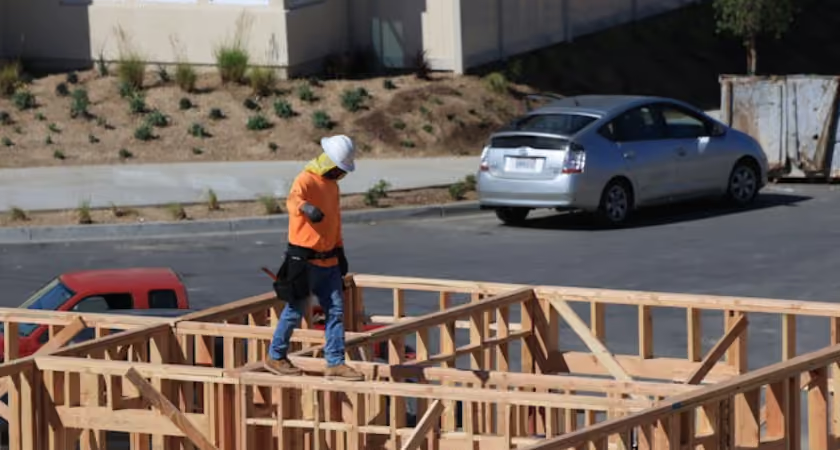
Project teams used building information modeling (BIM), constructability reviews, and system coordination during preconstruction to identify potential issues before field work began. Contractors also incorporated prefabricated framing and mechanical, electrical, and plumbing components to improve installation efficiency and reduce on-site disruptions.
According to project information released by the team, the development maintained budget consistency throughout the design process with limited value engineering and few scope reductions. Early coordination efforts also contributed to lower levels of field conflicts and change orders during construction.
The project delivered approximately 145 supportive housing units at a reported development cost of about $525,000 per unit, excluding acquisition expenses and reserve funding. Occupancy was achieved slightly more than two years after entitlement approval, a notable timeline for a permanent supportive housing project in a major California market.
The opening comes as municipalities across California continue searching for ways to increase affordable housing production amid escalating construction costs and financing challenges. Owners and developers are increasingly evaluating alternative delivery methods that provide greater cost certainty while reducing project risks.
For construction owners, the project highlights the potential benefits of involving contractors and trade partners earlier in the development process. Early pricing input, constructability analysis, and coordinated procurement strategies can help reduce surprises during construction while preserving project budgets for resident-focused amenities and community features.
As housing agencies and nonprofit developers work to expand affordable housing inventories, projects such as 1633 Valencia Street may offer a practical model for delivering supportive housing more efficiently while maintaining quality, schedule performance, and financial predictability.
Source: CAHILL.