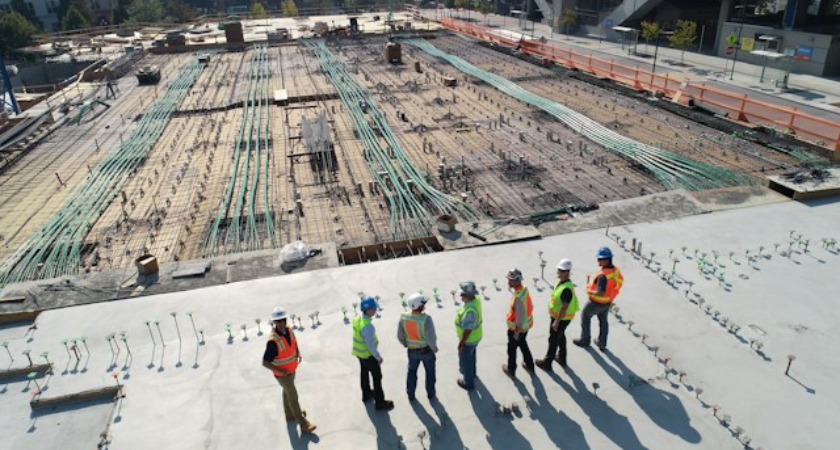
SACRAMENTO, Calif. — A sweeping new California law takes effect July 1 that will override local zoning restrictions and unlock a wave of mid- and high-density housing construction near transit corridors across eight counties — and contractors who understand it first will be best positioned to capture the work.
.webp)
Senate Bill 79, the Abundant and Affordable Homes Near Transit Act, is the most consequential piece of California's 2026 housing reform package for the construction industry. The law overrides local height and density limits to allow mid- or high-density housing projects near major public transit stops in eight counties: San Francisco, Alameda, San Mateo, Santa Clara, Sacramento, Los Angeles, Orange County and San Diego.
The law does not require developers to build — but it removes the primary obstacle that has blocked thousands of projects for years: local zoning.
SB 79 sets forth two tiers of allowable densities. In tier one, within one-quarter to one-half mile of heavy rail stations — such as Caltrain, LA Metro rail and BART — the act overrides any local zoning to allow a maximum residential development height of 65 to 75 feet, depending on the distance to the station. In tier two, within one-quarter to one-half mile of any qualifying light transit stops, including SF MUNI, Santa Clara VTA and Sacramento Regional Transit, the maximum allowable height is 55 to 65 feet.
For contractors, those numbers translate directly into project type and scope. Buildings in the 65-to-75-foot range typically run five to seven stories — dense wood-frame or podium construction that generates substantial subcontract volume across concrete, framing, mechanical, electrical and plumbing trades.
Beyond the height override, SB 79 carries a second benefit for the construction pipeline: speed. The law makes qualifying projects eligible for streamlined, ministerial approval under existing state law if they satisfy environmental, labor and affordability requirements, and authorizes local transit agencies to develop housing on land they own at equal or greater densities.
Ministerial approval means no discretionary review, no public hearing delays, and — critically — no California Environmental Quality Act exposure for qualifying projects. Combined with the CEQA streamlining already enacted under AB 130 and SB 131 effective Jan. 1, 2026, the path from entitlement to shovel is shorter than it has been in decades.
Developers and contractors in these markets should anticipate increased project volume and familiarize themselves with the statutory eligibility criteria that allow projects to bypass local zoning hurdles.
SB 79 does not arrive in a vacuum. Contractors working in California's private construction sector are already operating under two additional laws that took effect Jan. 1, 2026, and that will govern every project this new wave of transit housing generates.
SB 61 establishes a mandatory 5 percent cap on retention for most private construction contracts entered into on or after Jan. 1, 2026. The statute limits both progress-payment retention and total retention to 5 percent of the contract price and requires that retention percentages flow down consistently through all tiers of subcontracting. The retention limit cannot be waived by contract and includes an attorneys' fee provision for enforcement.
SB 440, the Private Works Change Order Fair Payment Act, creates standardized procedures and timelines for resolving claims and change-order disputes on large private projects. The law emphasizes timely notice and documentation and is scheduled to sunset in 2030 unless extended.
.webp)
Together, these three laws — SB 79, SB 61 and SB 440 — form an interlocking framework. SB 79 generates the projects; SB 61 governs how contractors get paid on them; and SB 440 establishes the rules for resolving disputes when change orders arise.
For contractors with operations or aspirations in Los Angeles, San Francisco, San Diego, Sacramento or the Bay Area, the preparation window is now. Firms should audit project pipelines near transit corridors to identify which sites qualify under SB 79's tiered density rules, update contract templates to reflect the SB 61 retention cap across all subcontracting tiers and train project management teams on SB 440's claim submission timelines.
The law does not supersede all local controls — local jurisdictions may adopt alternative Transit-Oriented Development plans subject to state oversight — but the burden of proof has decisively shifted. California is building near transit, and the contracts will follow.
This article is based on the legal alert "New California Construction Laws Taking Effect in 2026," published Dec. 30, 2025, by Michelle Akerman, Tom Li and Bianca Velez at Hanson Bridgett LLP. The full alert is available at hansonbridgett.com. Additional context draws from the Construction Owners Club's earlier coverage of California's 2026 construction law overhaul, available at constructionowners.com.