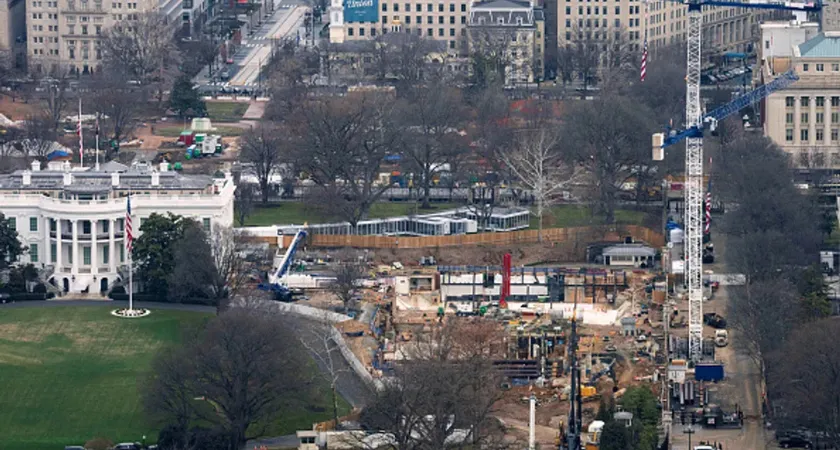
A federal judge has ordered construction to stop on Donald Trump’s $400 million ballroom project at the White House, marking a major legal setback for the high-profile development.
.webp)
U.S. District Senior Judge Richard Leon issued a preliminary injunction blocking “any action in furtherance of the physical development of the proposed ballroom at the former site of the East Wing of the White House.”
The ruling will take effect in 14 days, allowing time for the administration to appeal. Until then, all construction-related activities — including demolition, excavation and foundation work — must cease unless Congress authorizes the project.
The court’s decision hinges on whether the president has the authority to proceed with construction at the White House without congressional approval.
“In my view [the applicable U.S. statute] is most naturally read to require some form of authorization from Congress to construct a building, and an appropriation of funds-either a lump sum for construction or a specific appropriation for a particular project-would easily satisfy that requirement,” Leon wrote in his decision’s memorandum.
The ballroom project, funded through private donations according to the White House, had already advanced significantly — including demolition of parts of the historic East Wing in late 2025.
Leon’s ruling represents a legal win for the National Trust for Historic Preservation, which challenged the project over concerns about executive authority and preservation of historic federal property.
“I have concluded that the National Trust is likely to succeed on the merits because no statute comes close to giving the President the authority he claims to have,” Leon wrote in his memorandum. “The President of the United States is the steward of the White House for future generations of First Families. He is not, however, the owner!”
The halt affects key project partners, including Clark Construction, which was leading construction, and AECOM, serving as the project’s engineering lead.
Neither firm had responded publicly to the ruling at the time of publication, but the decision introduces immediate uncertainty around scheduling, costs and contract obligations.
For contractors, a stoppage of this scale typically triggers a range of implications — including demobilization costs, subcontractor delays and potential claims depending on contract terms.
The project has drawn widespread attention and criticism, including from architects and preservation advocates who questioned both its scale and design.
Donald Trump responded publicly on his platform, criticizing the lawsuit and defending the project’s value.
“The National Trust for Historic Preservation sues me for a Ballroom that is under budget, ahead of schedule, being built at no cost to the Taxpayer, and will be the finest Building of its kind anywhere in the World,” Trump posted.
The controversy adds to broader debates over transparency, executive power and the use of historically significant federal properties.
The administration now faces a narrow window to appeal the injunction or seek congressional approval to move forward.
If the ruling stands, the project could face extended delays — or potentially require legislative action before construction resumes.
Originally reported by Zachary Phillips, Editor in Construction Dive.