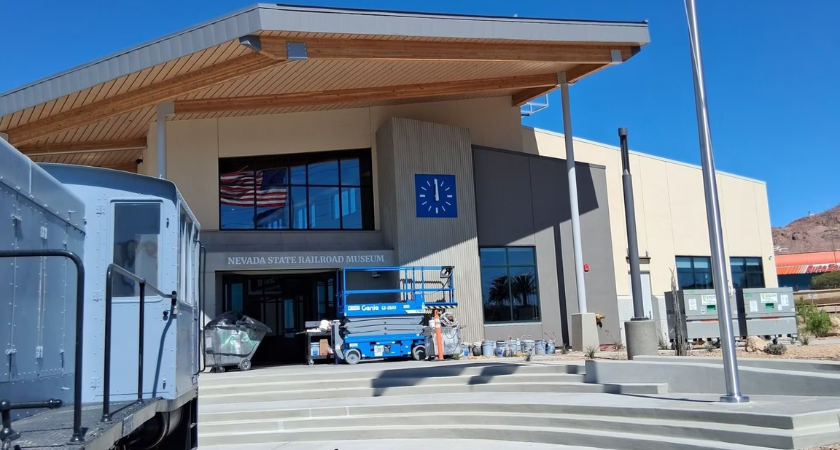
The ongoing expansion of the Nevada State Railroad Museum in Boulder City has reached a visible construction milestone with the installation of a new plaza clock and completion of several site infrastructure upgrades. The multi-phase redevelopment is reshaping the museum campus into a broader cultural and educational destination with improved visitor amenities and digital capabilities.

Recent construction activity includes final surfacing and striping of parking areas, along with installation of a new communications tower positioned near the planned visitor center footprint. The tower is part of a joint initiative between the museum and the Nevada System of Higher Education aimed at strengthening digital connectivity across the site.
Project planners have structured the redevelopment in three phases. The first phase focuses on building a new visitor center that will house museum exhibits and support guest services. The second phase is expected to introduce a linear park designed to improve walkability and public engagement across the campus. The final phase will expand railroad-themed exhibit areas, including a dedicated exhibit hall intended to support larger-scale displays and programming.
For construction stakeholders, the project reflects a broader trend in public cultural developments where museums are increasingly integrating infrastructure upgrades alongside traditional exhibit construction. Improvements such as high-speed communications systems and enhanced site circulation are becoming standard components of institutional expansions, particularly in projects tied to education and tourism partnerships.
From a delivery standpoint, the phased structure allows contractors to sequence work across civil, utilities, and vertical construction packages while maintaining partial site operations. This approach can help reduce disruption to ongoing public access areas while extending construction timelines across multiple bid cycles.
The inclusion of digital infrastructure within the museum’s physical expansion also highlights growing expectations for connectivity in public facilities. The communications tower is expected to support both operational needs and visitor-facing services, aligning with increasing demand for connected museum environments and hybrid educational programming.
For owners and public agencies, the expansion represents a long-term investment in regional tourism infrastructure, with construction work gradually transforming the site into a multi-use cultural corridor. As phases progress, contractors will continue to coordinate closely across civil works, utilities installation, and future vertical construction scopes tied to exhibit and visitor center development.
For construction owners and developers, the Nevada State Railroad Museum expansion highlights how modern public-sector projects are increasingly blending cultural development with utility-grade infrastructure improvements. What begins as a museum upgrade is effectively functioning as a mixed-scope capital project involving civil works, communications systems, public amenities, and phased vertical construction.
The inclusion of a dedicated communications tower and high-speed connectivity infrastructure signals a shift in owner expectations. Public assets are no longer being delivered as standalone buildings—they are being designed as digitally enabled environments. For owners, this expands early-stage planning requirements to include IT infrastructure, long-term connectivity partnerships, and coordination with higher education or public utility stakeholders.
The project’s three-phase delivery model also reflects a risk-managed capital strategy that owners can leverage in similar developments. Phased execution allows funding to be staggered, procurement to be spread across multiple cycles, and operational areas to remain partially active during construction. For owners, this approach can improve cash flow management and reduce shutdown risk, but it also requires tighter master scheduling and stronger interface coordination between civil, structural, and systems contractors.
From a contracting standpoint, the work reinforces the importance of packaging projects into clearly separated scopes—site preparation, utilities and communications, vertical construction, and public realm improvements. Owners who fail to clearly define these boundaries often face cost overlap, scheduling conflicts, and change order exposure, particularly in publicly funded developments.
The broader implication is that cultural and institutional projects are becoming hybrid infrastructure assets. Owners now need to think beyond building delivery and toward long-term operational performance, especially when projects integrate public access, education, and digital services within a single campus footprint.
Originally reported by Martha Cruz in Fox 5 Vegas.