Lawmakers in New York are advancing legislation aimed at converting vacant office buildings in upstate cities into housing, part of a broader strategy to address the state’s housing shortage while revitalizing underused downtown spaces.
.webp)
The proposal, backed by Pat Fahy and Crystal Peoples-Stokes, would expand access to tax credits designed to encourage developers to transform outdated office buildings into residential units.
Supporters say the measure could help address two persistent challenges: growing housing demand and increasing office vacancy rates following the shift to remote and hybrid work that accelerated during the COVID-19 pandemic.
“We've got to use every tool in the toolbox in order to grow housing,” Fahy said. “If we don't grow housing, we're going to continue to see prices go up.”
Across upstate New York cities—including Albany, Rochester and Buffalo—office vacancy rates have climbed sharply in recent years. According to lawmakers supporting the bill, more than 20% of downtown office space in these markets currently sits empty.
Much of the vacant space consists of older buildings that no longer meet modern workplace expectations.
“And it's dated office, it's not the prime office space, so giving an incentive to convert those office buildings to housing is really a win-win, because some of that is just not coming back. If anything, often people want the newer office buildings.”
Advocates say converting these properties into apartments could bring new residents into city centers while making better use of existing infrastructure.
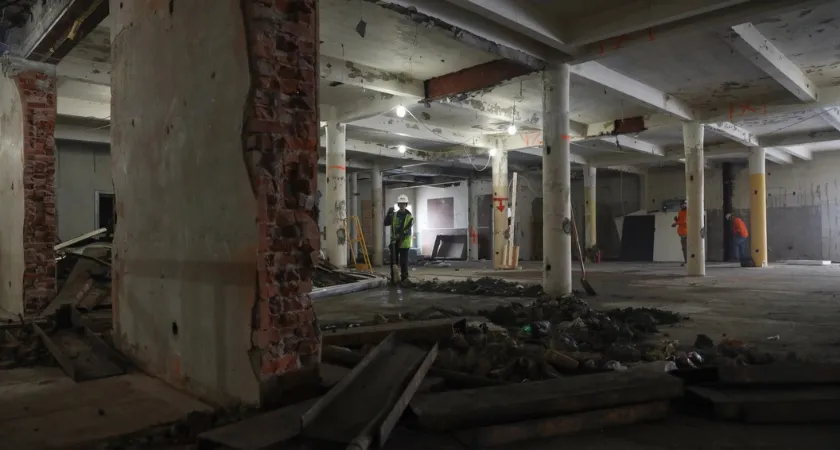
In Rochester, developers have already begun converting former office buildings into residential developments.
One project underway on East Main Street involves the transformation of an office building into the Gateway Apartments, a mixed residential complex expected to include studio, one-bedroom and two-bedroom units.
The development is being led by affordable housing developer SAA|EVI.
Managing partner Connor Kenney said the proposed tax incentives could make similar redevelopment projects financially viable.
“I think in many cases, it makes a lot of sense to repurpose office space to residential, but you know, there's going to be challenges when you go through that repurposing process,” he said. “And any sort of tax credit is going to help defray the added cost of the repurpose.”
Converting office buildings to housing can be complicated and expensive. Developers often need to reconfigure building layouts, update infrastructure, install residential utilities and create access to natural light for interior units.
Tax incentives can help offset these costs and make redevelopment projects more attractive to investors.
New York City has already seen an increase in office-to-housing conversions following the launch of a similar tax credit program, according to a report from the city’s comptroller.
State officials now hope to replicate that success in smaller upstate cities, where empty commercial buildings have become increasingly common.
Additional legislation introduced by Michaelle Solages and James Skoufis would also encourage redevelopment of other vacant commercial properties, including shopping malls and business centers.
The proposal would relax certain redevelopment rules if projects meet specific criteria aimed at increasing housing supply.
.webp)
Addressing housing shortages has become a central policy focus for Kathy Hochul.
Her administration has proposed a range of measures intended to speed up housing development, including changes to environmental review requirements for certain residential projects.
State officials argue that repurposing vacant commercial buildings could provide a faster path to creating new housing compared with constructing entirely new developments.
Beyond addressing housing shortages, office conversions could also play a role in revitalizing downtown districts that have struggled with declining office occupancy.
Adding residents to city centers can increase foot traffic, support local businesses and strengthen public transit systems.
Urban planners say that mixed-use neighborhoods—where people live, work and shop in the same area—are increasingly seen as a key strategy for creating more resilient cities.
If the proposed legislation is approved, supporters believe it could accelerate redevelopment projects across upstate New York, transforming vacant buildings into housing while breathing new life into aging downtown districts.
Originally reported by Samuel King in WXXI News.