Construction companies have long struggled with slow payments, paper invoices and outdated accounting systems. A Tennessee-based startup is aiming to change that.
.webp)
Founded in Nashville two years ago, Payra is building software designed to automate accounts receivable operations for large contractors and building materials suppliers — many of whom still rely on decades-old enterprise systems and paper-based workflows.
Last month, the company announced a $15 million growth investment from Edison Partners, marking its first outside capital raise after initially being bootstrapped by its founders. The funding will support expansion as Payra seeks to scale its footprint across construction and industrial trades.
Payra integrates with most enterprise resource planning systems used by “blue collar” businesses, modernizing how they collect and reconcile payments without requiring a costly replacement of legacy infrastructure.
A core challenge for contractors is that many operate on ERP platforms built decades ago — systems that often lack modern API connections or digital payment functionality.
“The vast, vast, vast majority of these businesses, they’re on ERP systems the general public probably hasn’t heard of, so the challenge is working with what they have in place versus pitching them a rip-and-replace strategy,” co-founder Thomas Cecil said.
Payra’s software allows contractors to accept digital payments such as credit cards and ACH transfers while automatically reconciling transactions within older accounting systems.
Via artificial intelligence-enabled technology, a payment “is actually now incorporated into my system of record, like the pacemaker of my business, and that largely, not to use too much hyperbole, wasn’t really possible before,” Cecil said last week in an interview.
“The magic for [companies] is that they’ve been basically told for the last 20 years, ‘Hey, you can accept credit cards, but you’re going to have to just figure out what that ties to,’” Cecil said.
Unlike retail-oriented accounting tools such as QuickBooks from Intuit, many construction-focused ERP systems were never designed for seamless digital payment integration.
Multiple firms — including Billtrust, Growfin and Versapay — offer receivables automation products. Payra says its differentiator lies in deep compatibility with legacy industrial ERP platforms, some nearly 30 years old.
The startup focuses on larger general contractors in commercial concrete, lumber, HVAC and electrical trades. These companies often dominate regional markets yet operate within fragmented industries.
Payra co-founder and CEO Riley Lovingood said the goal is to simplify the payment experience for both contractors and their customers.
“The biggest piece is alleviating a lot of the friction and making a general contractor have to go through hoops to pay somebody,” Lovingood said. “We’re providing more access to make it easier for them to pay … straight from the invoice on their phone, on their computer, right there.”
Many construction firms still manage receivables through paper invoices, mailed checks and manual spreadsheets, he added — processes that slow cash flow and increase administrative burden.
Payra generates revenue through a percentage of each transaction. While the company’s average credit card payment is about $3,500, significantly larger transactions are common.
“It was not weird for us to see credit card transactions north of $400,000,” Lovingood said.
Those high-ticket payments create additional processing challenges. Payra evaluated using solutions from Stripe and Braintree, an enterprise payments service owned by PayPal Holdings, but found them unsuitable for the construction sector’s risk profile.
“You can’t do that in this business because the tickets are so large that the risk controls of those modern processors will pend the payment or block the payment,” Cecil said.
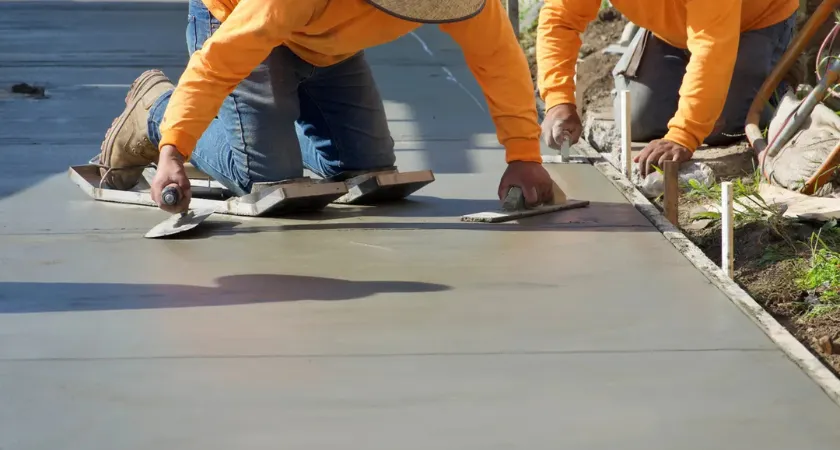
Lovingood pointed to the U.S. ready-mix concrete market — made up of roughly 12,000 companies — as an example of Payra’s target customer base.
“They each dominate a circular radius between where the plants are because it’s a perishable product, you can’t ship concrete,” he said. “It’s very fragmented or balkanized. Everybody sort of has their own territory.”
Because these firms often lack enterprise-grade payment infrastructure despite significant revenue volumes, Payra sees opportunity to streamline collections, improve liquidity and reduce days sales outstanding (DSO).
.webp)
As construction companies face tighter margins, rising material costs and prolonged project timelines, faster receivables processing can significantly improve working capital management.
By automating reconciliation and embedding digital payments directly into legacy ERP systems, Payra aims to reduce administrative overhead while accelerating cash flow — a critical factor for contractors managing payroll, equipment and supplier expenses.
With fresh funding and a direct-sales growth strategy, the 14-employee startup is positioning itself as a niche fintech player tailored specifically to industrial trades.
Whether Payra can scale nationally in a conservative, relationship-driven industry remains to be seen. But as contractors increasingly seek modernization without overhauling their entire tech stack, demand for hybrid solutions that bridge old and new systems may continue to grow.
Originally reported by Justin Bachman, Senior Reporter in Construction Dive.