A new benchmark report shows that little progress has been made to improve the state of women in construction. Four in five women report having their expertise questioned on the job. Eight in ten cannot rely on access to proper restrooms. Women are leaving the industry at three times the rate of men.
She has been in construction for over 25 years. She has managed crews, overseen projects worth millions of dollars, navigated union halls and boardrooms, and outlasted every colleague who once told her this industry wasn’t for her. And yet, on a job site last year, someone still questioned whether she knew what she was doing.
She is not alone. Not even close.
The She Builds Nation 2026 Report, a benchmark survey published this month by construction workforce platform Lumber, in partnership with ConstructionOwners, BuilderFax, Workify Staffing, and Ambition Theory, delivers findings that are equal parts revelatory and frustrating.
The report is based on responses from 50 women working across U.S. and Canadian construction in trades ranging from electrical and masonry to civil grading and project management.
Its central message: the construction industry is hemorrhaging female talent it cannot afford to lose, and the reasons are neither mysterious nor unsolvable. They are just unaddressed.
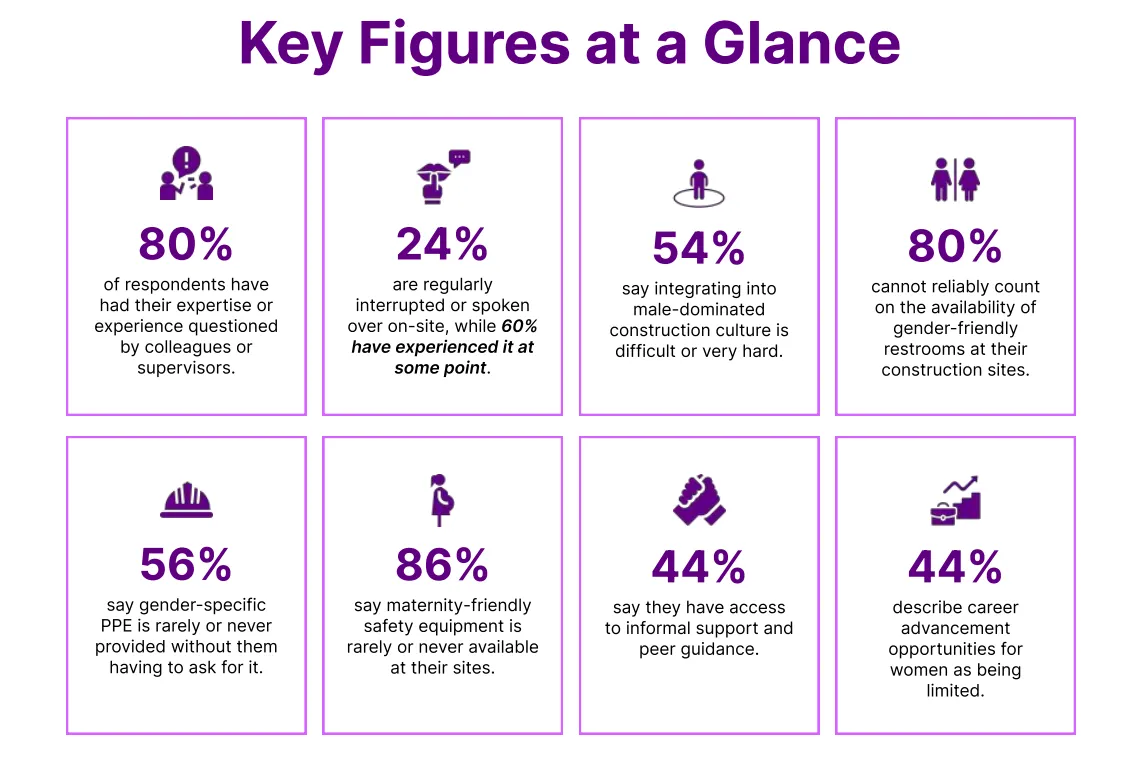
The headline statistic from the 2026 report is staggering in its simplicity: 80% of respondents have had their expertise or experience questioned by colleagues or supervisors on construction sites. Only 2% said it had never happened to them.
Read that again. Eight out of ten women — across roles, seniority levels, company sizes, and years of service — routinely face challenges to their basic competence. It happens to first-year apprentices and to owners of multi-million-dollar construction firms.
“I own a multi-million dollar company, and they still do. I have to show my teeth every time, and it’s exhausting.”
— Anonymous survey respondent
This quote highlights the exhaustion of building a career in an environment that consistently questions women's credibility.
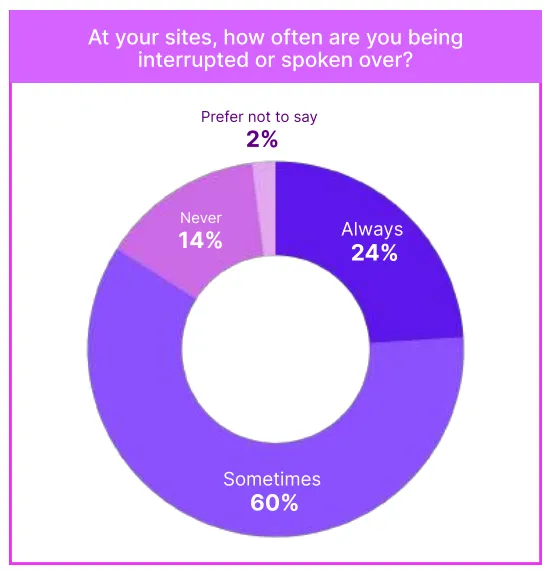
Sixty percent of respondents report being interrupted or spoken over on-site, while 24% say it happens consistently. Only 12% say it never occurs. The report concludes this is not simply discourtesy, but a systematic refusal to recognize women as authoritative voices in their workplaces.
This issue extends beyond fairness. In 2026, the construction sector faces a severe and worsening labor shortage. A federal infrastructure boom has increased demand for skilled workers as the baby boomer generation retires. Industry projections indicate that hundreds of thousands of positions will need Women now represent 11.2% of the total construction workforce, the highest share in two decades. However, they make up only 4% of on-site construction and trade roles, where labor shortages are most severe.
And women leave the trades at three times the rate that men do.
Shreesha Ramdas, CEO and Co-Founder of Lumber, frames it bluntly in the report’s conclusion: “Women make up half the population, bring extraordinary skill and leadership to this industry, and are leaving it at three times the rate of men — not because they want to, but because the conditions are pushing them out. That is not a talent problem. That is a leadership problem.”
Beyond the cultural barriers, the 2026 report documents the persistence of physical and logistical failures that should, by now, be embarrassing for an industry of this size and economic weight.
Gender-friendly restrooms remain a significant issue. Two years ago, 64% of respondents identified the lack of proper sanitation facilities as a major challenge. The 2026 follow-up shows little improvement: 80% of women still cannot rely on gender-friendly restrooms at their sites. Only 18% report that such facilities are always available.
This was one of the most discussed, most cited, and most practically solvable issues from the first report. The industry has largely failed to act on it. When a woman arrives at a construction site, and there is nowhere appropriate for her to use the restroom, the message is not subtle.
Protective equipment. 56% of respondents say gender-specific PPE is rarely provided without them needing to ask for it. On maternity safety equipment — harnesses and gear designed for pregnant workers — 86% say it is rarely or never available. Only 2% say it is always accessible at their work sites.
The report is clear: requiring pregnant women to use standard harnesses is a safety failure. Appropriate equipment exists, but the industry has not adopted it as a standard.
Perhaps most troubling for those who believed the industry was turning a corner is the data on cultural integration. In 2026, only 8% of respondents described the construction environment as easy or welcoming. 34% say it is difficult with frequent issues. 20% say it is very hard with constant challenges. 38% describe it as merely manageable.
Fifty-four percent of women surveyed are actively struggling to integrate into their workplace culture. Most of the remaining respondents are simply enduring the environment.
Jennifer Todd, President of LMS General Contractors and a prominent voice in the 2024 editions of the report, put the issue in terms every contractor should internalize: “It’s not a construction issue, it’s a workplace culture issue. If the goal is to attract the next generation, the construction industry must shift from being project-centered to people-centered.”
The broader cultural reckoning that many hoped would follow the renewed focus on diversity and inclusion appears to have stalled — or in some environments, provoked a backlash rather than a welcome.
Findings on career advancement are concerning. Only 12% of respondents describe advancement opportunities for women in construction as abundant. Thirty-eight percent consider them moderate, 44% say they are limited, and 4% report there are none.
Mentorship opportunities are only slightly better. Forty-four percent report access only to informal peer guidance, such as word-of-mouth networks or online communities. Only 24% have access to formal, structured mentorship programs.
Advancement opportunities may exist on paper, the report concludes, but the pathway to them runs through a culture that is not yet built to carry them there.
Andrea Janzen, Founder and CEO of Ambition Theory and creator of the 10,000 Women Leaders Movement, adds an important frame: “When 80% of women say their expertise has been questioned and nearly half describe advancement opportunities as limited, that signals something deeper than individual experience. It tells us we need to reexamine how we define leadership potential. Expanding the definition doesn’t mean lowering the bar. It means recognizing the full range of leadership strengths our industry needs.”
"The She Builds Nation 2026 report highlights both the progress made and the challenges that remain for women in construction. While the industry has seen incremental improvements, such as a slight increase in the overall representation of women, significant barriers like credibility, workplace culture, and access to gender-friendly resources persist. These findings underscore the urgent need for sustained leadership and institutional commitment to create a more inclusive and supportive environment. Together, we can build a future where women thrive and contribute fully to the construction industry." Allison Walters, President, Workfiy Staffing.
The She Builds Nation 2026 report provides clear direction, identifying three areas where action is not optional but overdue.
On physical infrastructure, the fix is logistical: audit every site, add gender-friendly facilities, and include women’s sizing in standard PPE procurement orders. The tools and knowledge to solve both problems exist. What’s missing is the decision to treat them as non-negotiable.
On culture and credibility, the fix requires leadership: model different behavior, interrupt the interrupters, explicitly credit women’s contributions, and enforce standards of respect. Culture is set from the top. Companies whose leaders tolerate dismissiveness will keep watching women walk out the door.
On career infrastructure, the fix is institutional: sponsorship programs, formal mentorship structures, clear criteria for advancement, and deliberate outreach to ensure women know those pathways exist. Other industries have built these systems. Construction has largely not.
“The labor shortage in construction is real. The solution is standing right in front of us.”
The women who responded to this survey are electricians and general contractors, superintendents and safety directors, project managers, and business owners with decades of experience. They are, by every measure, exactly the talent the construction industry says it desperately needs.
The She Builds Nation 2026 Report does not tell a story of progress. It tells a story of unfinished work — and in some dimensions, of ground lost. The industry has the data, the business case, and the human cost laid out before it. What it does next is the only question that matters.
The She Builds Nation 2026 Report is published by Lumber and available at lumberfi.com/shebuildsnation.