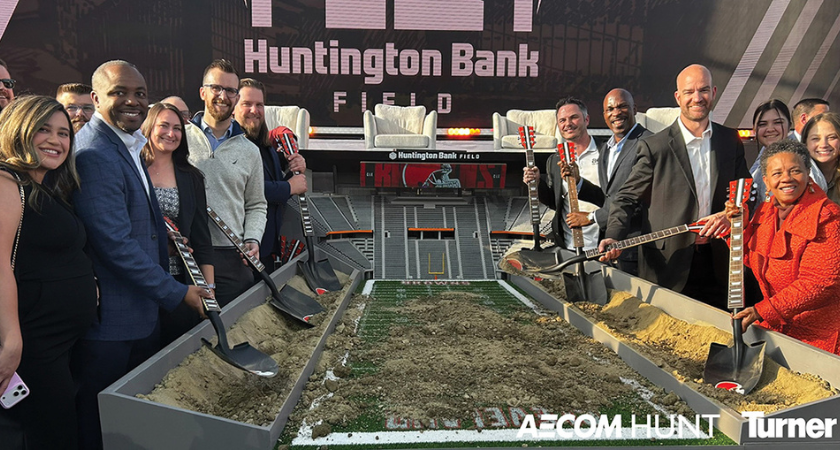
A large-scale sports and entertainment development in Northeast Ohio has officially entered the construction phase, marking the start of one of the most significant stadium projects currently underway in the United States.
The project centers on a new enclosed NFL stadium that will serve as the future home of the Cleveland Browns and anchor a broader mixed-use development district. Construction management responsibilities are being led by Turner Construction Company in partnership with AECOM Hunt, both of which bring extensive experience in major venue delivery across North America.
For construction owners and industry stakeholders, the project signals continued strength in large-scale sports and entertainment investment, particularly in major metropolitan redevelopment corridors.
Unlike traditional single-asset stadium builds, the Huntington Bank Field project is structured as a multi-phase development that includes surrounding commercial, entertainment, and hospitality components.
The broader district is intended to generate year-round economic activity rather than relying solely on event-based revenue. This approach reflects a growing trend in professional sports infrastructure, where stadium construction is increasingly tied to mixed-use urban redevelopment strategies.
The project is expected to serve as a long-term anchor for private investment in the surrounding area, with phased development extending beyond the stadium opening timeline.
The stadium design incorporates several technically complex elements that elevate the project beyond standard venue construction.
Key design and construction features include:
These elements place the project firmly in the category of complex, high-risk construction delivery, requiring coordinated execution across multiple specialty trades, advanced structural systems, and phased sequencing strategies.
Large stadium developments of this scale typically generate sustained labor demand across multiple construction disciplines, including structural steel, concrete, mechanical systems, and interior buildout packages.
The project is expected to support thousands of construction-related jobs over its multi-year build cycle, with additional long-term employment created through ongoing operations and surrounding district development.
For contractors and subcontractors, projects of this nature often drive competitive pressure on skilled labor availability, particularly in structural, mechanical, and electrical trades where large-scale venue experience is required.
The use of local subcontractors alongside national firms also reflects a hybrid delivery model increasingly common in major infrastructure and sports projects, balancing regional economic participation with national-level project expertise.
For industry participants, the project highlights several key trends shaping the current construction market:
1. Mega-project delivery continues to anchor industry backlog
Large-scale stadium and mixed-use developments remain significant contributors to long-duration construction pipelines.
2. Joint venture delivery models are standard for complex projects
Projects of this scale increasingly rely on multi-firm collaboration to manage technical complexity and risk distribution.
3. Mixed-use integration is redefining stadium economics
Revenue models now extend beyond sports usage to include retail, entertainment, and hospitality development.
4. Skilled labor demand remains concentrated in specialty trades
Mechanical, electrical, structural steel, and advanced enclosure systems continue to face strong demand pressure.
5. Regional subcontracting remains essential to project execution
Even large national contractors depend on local partners for site development and trade-specific execution support.
Originally reported by Turner Construction.