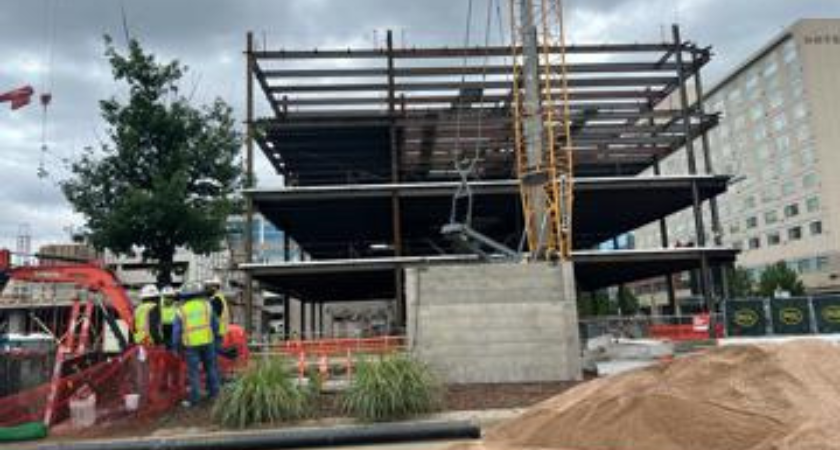
A long-planned redevelopment in Denver’s Cherry Creek North neighborhood is taking shape as a new flagship office building rises at the center of the Cherry Lane project. The development replaces aging retail structures with a modern commercial anchor designed to support office, retail, and residential activity in one of the city’s most active urban districts.
The project site, located at First Avenue and Clayton Lane, previously housed mid-century retail buildings that were cleared to make way for a denser, mixed-use environment adjacent to established commercial destinations, including a nearby grocery-anchored retail center.
For construction stakeholders, the project represents continued momentum in urban infill development, where land redevelopment is driving multi-phase construction schedules and long-term tenant buildouts.
At the center of the Cherry Lane development is a six-story office building totaling approximately 55,000 square feet. The structure is designed to serve as a consolidated Colorado hub for UMB Financial Corporation’s commercial banking, wealth management, and executive operations.
The building will include a ground-floor banking branch, with office floors above dedicated to corporate functions. The project reflects a broader trend in financial sector real estate strategy, where institutions are shifting toward purpose-built, consolidated office environments rather than dispersed leased locations.
Construction sequencing places emphasis on phased delivery, with exterior completion targeted for spring 2027 and tenant move-in anticipated in 2028 following interior buildouts.
The Cherry Lane project is being delivered through a partnership between BMC Investments, Prism Places, and Invesco Real Estate. The development combines office, residential, and pedestrian-focused retail components intended to increase year-round activity within the district.
The surrounding plan includes multi-family housing and street-level commercial space designed to support foot traffic and create a continuous urban retail corridor. The integration of office and residential uses is central to the project’s long-term leasing and occupancy strategy.
The Cherry Creek North redevelopment highlights several key trends influencing urban construction pipelines:
For contractors and developers, projects of this type require coordinated sequencing across demolition, core and shell construction, and tenant interior fit-outs, often extending total delivery timelines beyond five years.
For owners, developers, and construction managers, the Cherry Creek project underscores how flagship tenants are reshaping urban office development strategy. Rather than speculative office construction, projects are increasingly anchored by committed end users who influence building design, phasing, and infrastructure requirements.
Contractors operating in similar markets can expect:
As urban cores across major U.S. cities continue to evolve, projects like Cherry Lane signal a steady shift toward integrated, long-term district planning rather than standalone commercial development.
Originally reported by Alexander Kirk in 9 News.