The rapid growth of global data-center construction is introducing new safety concerns for construction workers, according to a recent industry analysis released by Safety Systems Management, a provider of wireless emergency notification systems designed for complex construction environments.

Demand for digital infrastructure continues to surge as companies expand cloud computing services, artificial intelligence capabilities, and large-scale data storage facilities. This growth is driving a dramatic expansion in data-center development worldwide.
Industry projections estimate the global data-center construction market—valued at $240.97 billion in 2024—will grow to approximately $456.5 billion by 2030, representing a compound annual growth rate of 11.8%. As projects expand in scale and complexity, safety professionals warn that conventional jobsite communication systems may no longer be sufficient.
“Data centers are among the most technologically advanced facilities in the world, but building them can be incredibly challenging from a safety perspective,” said Cory Sherman, CEO of Safety Systems Management. “These projects involve massive campuses, high-energy electrical infrastructure, constantly changing schedules, and thousands of workers moving across multiple buildings. Without modern communication tools, safety teams can struggle to respond quickly when incidents occur.”
Eight Emerging Safety Risks on Data-Center Projects
According to Safety Systems Management, several factors are making data-center construction projects fundamentally different from traditional commercial building sites.
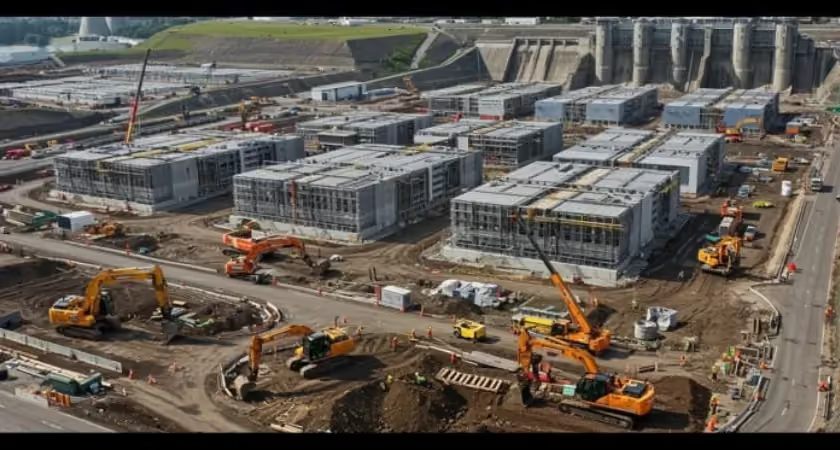
One of the most significant challenges is project scale. Hyperscale data-center campuses can span hundreds of acres and contain numerous buildings, making it difficult for safety managers to quickly communicate with every worker during emergencies.
At the same time, many facilities are constructed through simultaneous multi-building development, where data halls, substations, cooling towers, and power infrastructure are built concurrently. This overlapping work environment increases the risk of jobsite hazards.
Location is another major factor. Data centers are often intentionally placed in remote areas where land and power are readily available but emergency services may be miles away. In such cases, fast internal communication becomes essential during incidents.
Electrical infrastructure also presents major hazards. Construction crews frequently work around high-energy electrical systems, including energized switchgear, backup generators, and distribution networks. In the event of an arc-flash or electrical emergency, rapid notification and coordinated response are critical.
Projects are also being completed on accelerated timelines due to demand for digital infrastructure, leading to rapidly changing construction schedules and site logistics.
Workforce turnover can add another layer of complexity. Large data-center developments often rely on thousands of rotating workers and subcontractors, making consistent safety messaging difficult to maintain across the project.
Environmental conditions also play a role. Large campuses with limited shelter are particularly vulnerable to severe weather risks, including lightning storms, high winds, extreme heat, and wildfire smoke.
Finally, manual emergency mustering—confirming that all workers have evacuated safely—can become slow and error-prone when projects involve multiple buildings and large workforces.
Communication Technology Becoming Critical
Sherman said many of these challenges ultimately stem from communication limitations on large construction sites.
Traditional jobsite alerts such as air horns, handheld radios, and verbal instructions may not reach workers spread across large campuses or inside structures with sound-dampening materials.
Wireless emergency notification systems are increasingly being used to address these limitations by allowing safety managers to instantly send alerts across multiple channels, including mobile devices, wearable technology, sirens, and strobe systems.
These systems can also issue zone-specific alerts, allowing crews to evacuate a single building or section of a site without disrupting the entire project.
In emergencies such as medical incidents or electrical hazards, the technology can significantly reduce response time by directing crews and first responders to the precise location of the issue.
“Data-center construction is only going to accelerate as digital infrastructure becomes more critical to the global economy,” Sherman said. “To keep workers safe in these complex environments, the industry needs communication systems that are just as advanced as the facilities being built.”
Expanding Digital Infrastructure Raises Safety Stakes
The rapid rise of data-center development reflects the growing demand for digital services across industries. From artificial intelligence platforms to cloud storage and high-performance computing, the need for large-scale data facilities continues to intensify.
However, the speed and scale of these developments are pushing construction operations into new territory, requiring updated safety strategies, better communication tools, and more coordinated emergency response systems.
Industry experts say improving jobsite communication and emergency notification systems will be essential to ensuring worker safety as data-center construction continues to expand across global markets.
Originally reported by Safety Syatems Management in Construction Dive.