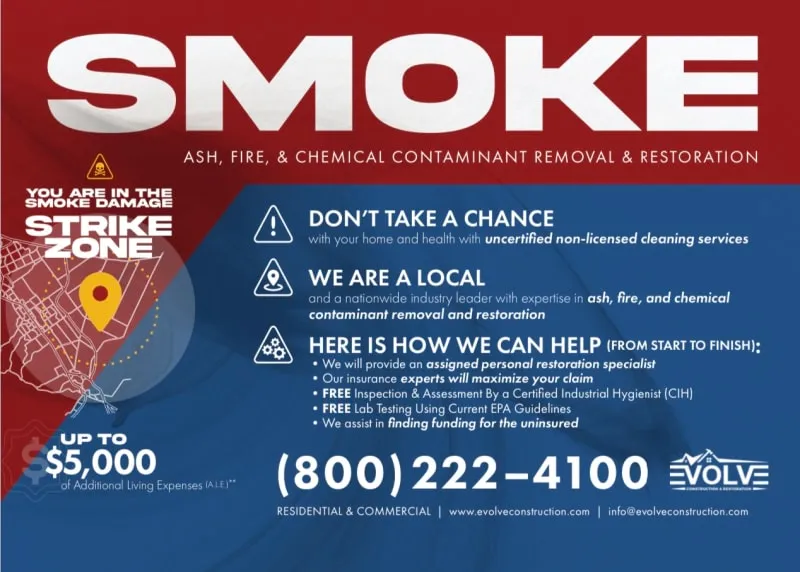
Evolve Construction and Restoration has launched a new multi-state initiative aimed at helping homeowners address hidden smoke contamination following fire events.
The company, led by founder Jaser "Jay" Zaabri, has partnered with ClearAirCheck and Priority Labs to roll out the “Community Restoration Drive” in Woodward and Lubbock.
The initiative builds on the coalition’s previous work in Altadena and Pasadena, where it helped more than 1,000 homeowners secure over $100 million in wildfire-related insurance claims after the 2025 Los Angeles wildfires.
Expanding a Proven Wildfire Recovery Model
The coalition’s earlier efforts in California established a comprehensive approach that combines testing, claims advocacy and full restoration services. In communities heavily impacted by wildfire smoke, the team conducted industrial hygiene assessments and laboratory analysis to identify contamination that is often invisible.
"Visible fire damage is only the beginning. The real threat is what you cannot see. The Community Restoration Drive puts all the pieces together: expert testing and lab analysis, fair insurance advocacy and professional restoration that brings homes back stronger and safer."
— Jaser "Jay" Zaabri, founder and chairman, Evolve Holdings.
In Altadena and Pasadena alone, more than 13,000 standing homes were affected by smoke contamination, highlighting the widespread but often overlooked nature of post-fire damage.
Lab Findings Reveal Hidden Indoor Contamination
Testing conducted in Woodward has already identified significant levels of combustion byproducts inside residential and commercial properties. Analysis by Priority Labs detected soot, char and ash-like particles across multiple sites, including HVAC systems—indicating that contamination is circulating within indoor environments.
"Without proper testing, many affected properties would go untreated. A 20% soot concentration at an occupied commercial location is a measurable contamination finding that warrants professional assessment."
— Dr. John Shane, Priority Labs, Indianapolis, Ind.
Experts emphasize that smoke damage can persist long after a fire is extinguished, embedding into materials and impacting indoor air quality.
"One of the biggest misconceptions homeowners have after smoke events is that no visible damage means no problem. Combustion particles can infiltrate HVAC systems, settle on surfaces and embed into porous materials long after a fire event has passed."
— Dave Carlson, Evolve Fire & Smoke operating partner.
“Smoke contamination doesn’t respect property lines or zip codes. What we’re finding in Woodward and Lubbock mirrors exactly what we documented in Altadena and Pasadena — combustion particles infiltrating HVAC systems, embedding into porous building materials and circulating through occupied spaces long after the visible fire event has passed. The lab data from Priority Labs confirms what industrial hygiene science has shown for decades: if you were in the smoke path, you need to test before you assume you’re safe. The Community Restoration Drive exists to make that process accessible, documented and defensible for every homeowner and business owner we serve.”
— Licensed Industrial Hygienists, ClearAirCheck.com
Coordinated Services to Support Recovery
The initiative offers a full-service recovery pathway, integrating environmental testing, lab verification, insurance claims support and physical restoration.
ClearAirCheck is responsible for field testing and contamination mapping, while Priority Labs provides certified lab analysis. Claims advocacy is handled by Chris Dorris in Oklahoma and Alpha Public Adjusters in Texas, ensuring homeowners receive fair compensation.
"Homeowners in this region are filing claims without knowing that invisible smoke contamination may be the most significant damage in their property. Our role is to ensure they are informed before an adjuster closes their file."
— Chris Dorris, KeyAdjusters.com, Woodward, Okla.
Additional & Expanded Insights
The initiative comes amid growing legislative and regulatory attention to smoke damage claims. States like Colorado have already introduced policies to prevent insurers from limiting coverage for smoke-related damage, while California is advancing legislation to standardize testing and restoration practices.
As wildfire frequency and intensity increase across the U.S., experts say smoke contamination is becoming a major public health and insurance issue. Unlike visible fire damage, smoke particles can spread across large geographic areas, affecting homes and businesses far from the fire’s origin.
The Community Restoration Drive aims to bridge this gap by making professional testing and restoration more accessible, particularly in regions that may lack awareness or resources to address post-fire contamination.
Key Takeaway
Evolve’s multi-state initiative highlights a critical shift in disaster recovery—moving beyond visible damage to address hidden smoke contamination, while helping homeowners secure fair insurance outcomes and restore safe living environments.
Originally reported by Evolve Construction & restoration in Construction Dive.