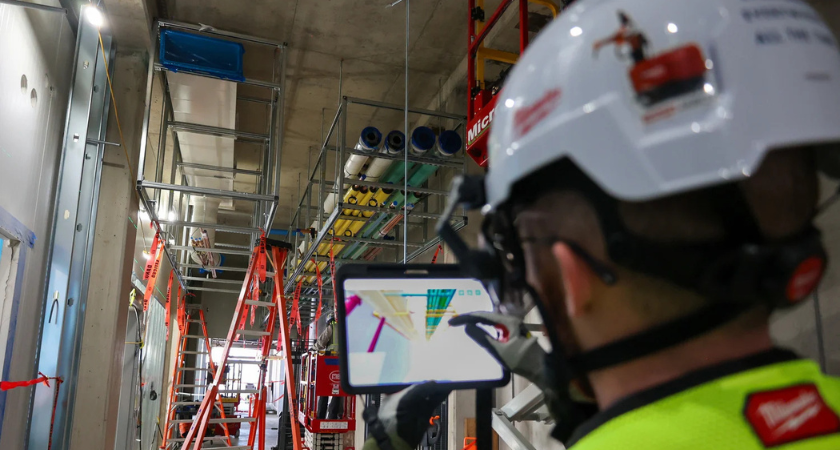
As federal construction projects grow more technically complex and schedule-driven, contractors are increasingly turning to prefabrication strategies to reduce risk, improve safety performance and maintain delivery timelines. A new laboratory project tied to the U.S. Department of Energy is becoming an example of how off-site construction methods are gaining traction in advanced research and mission-critical facilities.

JE Dunn Construction recently completed a major prefabrication effort at the National Laboratory of the Rockies Energy Materials & Processing at Scale facility, a 129,000-square-foot research building designed to support advanced scientific operations. The contractor utilized 66 prefabricated multi-trade racks to support building systems throughout the three-story laboratory.
The project is also serving as a pilot under the Department of Energy’s Cooperative Construction Contracting Approach, a procurement framework intended to improve collaboration and project execution on federal work.
The prefabricated rack assemblies consolidated multiple building systems into modular units that were manufactured off-site and later installed within the facility’s utility corridors. Each rack measured roughly 20 feet long, with two parallel rack runs installed on each level of the building.
For contractors working in laboratory and research environments, the strategy reflects a broader industry shift toward manufacturing-style construction practices that reduce field congestion and improve coordination among trades.
Project teams involved in the effort said the prefabrication approach enabled earlier coordination between mechanical, plumbing, electrical and specialty contractors. Systems were designed and tested in a controlled fabrication environment before reaching the project site, reducing field conflicts and minimizing installation delays.
The off-site fabrication process also addressed one of the industry’s most persistent challenges: labor efficiency.
By moving a substantial portion of work away from the active jobsite, crews reduced trade stacking, overhead work and material handling risks. Project leaders estimated that nearly 70% of labor hours associated with the rack systems were completed off-site, contributing to zero recordable safety incidents during the prefabrication scope.
The strategy also played a major role in maintaining schedule certainty on a project with limited installation windows and little tolerance for rework. Rather than relying on sequential field installation inside congested utility corridors, contractors fabricated and staged completed systems while core building construction continued simultaneously.
The modular systems were produced at an off-site facility located near the project. Fabrication included structural assembly, electrical integration, insulation, painting and protective wrapping before delivery to the laboratory site.
Mechanical contractor MTech led engineering and fabrication efforts for the rack systems, while Encore Electric handled electrical pathway installation. Additional specialty contractors supported painting and insulation work.
Industry observers say the approach reflects growing momentum behind prefabrication and industrialized construction methods across healthcare, laboratory, semiconductor and advanced manufacturing projects. Owners are increasingly prioritizing delivery certainty and workforce efficiency as labor shortages and supply chain pressures continue to affect project timelines nationwide.
The use of digital coordination tools, pull-planning methods and early collaboration with inspection authorities also underscores how contractors are adapting project management practices to support modular delivery models.
Another key component of the project involved designing the racks for future flexibility. The assemblies were intentionally engineered with additional weight capacity to accommodate future system expansion without major structural modifications — an increasingly important consideration for research facilities expected to evolve over time.
For construction owners and developers, the project demonstrates how prefabrication is moving beyond simple modular applications into highly technical and mission-critical environments. Owners facing labor shortages, compressed schedules and rising project complexity may increasingly view off-site construction as a strategic tool rather than a niche delivery method.
The ability to fabricate systems in controlled environments can help improve quality assurance, reduce onsite safety exposure and create more predictable installation schedules. For owners operating in healthcare, federal, data center, laboratory and industrial sectors, these advantages can directly affect operational readiness and project costs.
The project also highlights the importance of early collaboration among contractors, trade partners and code authorities. Owners considering prefabrication strategies may need to engage design teams, inspectors and suppliers earlier in the planning process to maximize efficiency gains.
As federal agencies and private-sector clients continue prioritizing resilience, workforce efficiency and schedule certainty, projects using integrated prefabrication strategies could become more common across large-scale construction programs.
Originally reported by JE Dunn Construction.