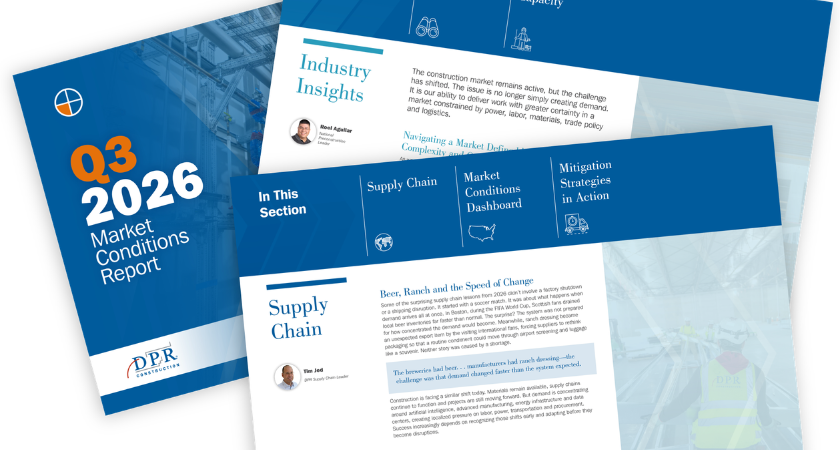
Construction owners and contractors are operating in a market where demand remains strong, but the capacity to deliver projects is becoming increasingly constrained. DPR’s Q3 2026 Market Conditions Report identifies power availability, skilled labor, material costs, trade policy and logistics as major factors influencing project schedules, costs and procurement decisions.
Released Sept. 8, the report examines construction activity across major market sectors and outlines conditions expected to influence project delivery through 2027. Investment remains active in digital infrastructure, health care, transportation, advanced manufacturing and energy, but demand is increasingly concentrated among projects competing for the same resources.
Data center construction remains a major source of demand as artificial intelligence, cloud computing and enterprise technology investments continue to expand. The resulting activity is affecting other construction sectors because projects increasingly compete for electricians, mechanical trades, generators, switchgear, transformers, manufacturing capacity and utility infrastructure.
DPR said power availability has become a strategic consideration for large development projects. Utility capacity, load requirements, energization strategies, temporary power and long-lead electrical equipment increasingly need to be evaluated during site selection and early project planning.
Skilled labor remains another major constraint. Electricians, pipefitters, welders, commissioning specialists, controls technicians and experienced field supervisors are among the workers in high demand.
The report said the issue is increasingly a capacity challenge rather than simply a labor shortage. Construction teams must secure qualified workers in the right locations and at the right time while maintaining safety, quality, productivity and schedule requirements.
Material markets continue to produce mixed conditions for construction projects. DPR reported that the producer price index for new nonresidential construction inputs increased 8.4% year over year through May 2026, the largest annual increase since the pandemic period.
Diesel fuel, structural steel, aluminum, copper and freight costs remain important cost considerations. Electrical infrastructure equipment is particularly exposed because transformers, switchgear, generators and power-distribution equipment are in demand across multiple high-growth sectors.
DPR cited generator lead times of about 40 weeks, while some transformer lead times have reached approximately 150 weeks. Structural steel availability also varies considerably depending on sourcing and supplier capacity.
Roofing materials are facing additional pressure. TPO and PVC roofing systems currently have lead times of approximately four to six weeks, while roofing insulation averages about three months, according to the report.
Trade policy is adding further uncertainty. Tariff changes affecting steel, aluminum, copper, electrical components, machinery and other imported products can influence material costs, supplier behavior, sourcing decisions and transportation strategies.
Transportation networks continue to operate, but construction teams have less room for schedule disruptions. Freight costs, fuel surcharges, capacity limitations, shipping changes and geopolitical conditions can affect when critical materials reach jobsites.
DPR also identified changing trade policy as an increasingly important procurement consideration. Construction companies may need to evaluate supplier manufacturing locations, alternative sources, tariff exposure and landed costs rather than relying solely on quoted prices.
The report recommends greater emphasis on early planning and procurement visibility. Owners and project teams can reduce exposure by identifying long-lead items, coordinating with utilities early, evaluating supplier alternatives and developing contingency strategies before market constraints become schedule problems.
DPR expects construction demand to remain supported by artificial intelligence and digital infrastructure, energy investment, grid modernization, advanced manufacturing and infrastructure development.
However, the report indicates that labor availability, power capacity, material lead times, trade policy and supply chain resilience will continue to influence project execution.
For owners and contractors, the market is shifting toward earlier decision-making. Procurement, utility coordination, workforce planning and logistics can no longer be treated solely as downstream project activities.
The broader industry takeaway is that construction demand remains substantial, but project success increasingly depends on the ability to identify capacity constraints early and respond before they affect cost and schedule. Organizations that maintain supply chain visibility, develop sourcing flexibility and coordinate critical decisions earlier will be better positioned to manage the market conditions expected through 2027.
Source: DPR.