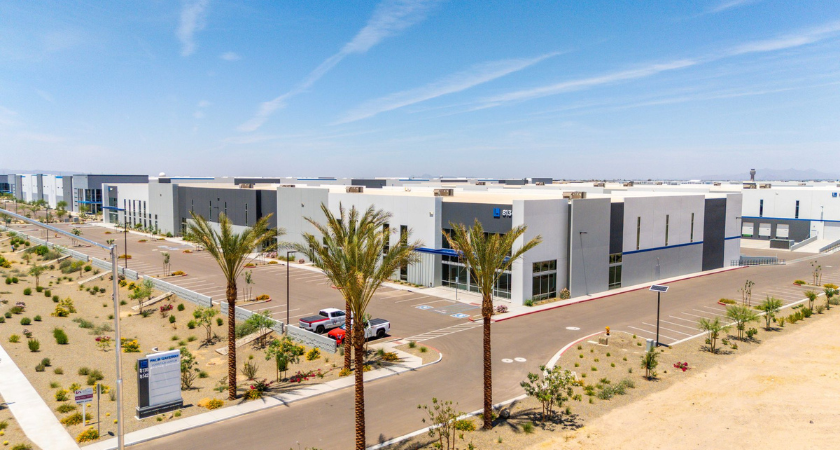
JOLIET, Ill. — One of the most significant construction projects in Illinois history is now moving forward after the Joliet City Council voted 8-1 on March 20 to approve a 795-acre AI data center campus that will rival New York's Central Park in footprint, generate up to 10,000 construction jobs and pump an estimated $2.1 billion in tax revenue into the region over the next 30 years.
.webp)
The Joliet Technology Center is a proposal from Hillwood Investment Properties, a Dallas-based developer founded by Ross Perot Jr., to build out a 24-building campus for potential hyperscaler users like Google, Amazon and Meta, in partnership with PowerHouse Data Centers.
The council approval was for an annexation agreement for the Jackson Township site located in the area of Rowell and Bernhard roads. The vote came after a public hearing Monday, March 16 that stretched 6½ hours before being recessed past midnight to avoid violating a state law banning public meetings on primary election days.
The Joliet Technology Center is designed for four sub-campuses, each of which would contain six buildings. Buildings would be two stories, and the total square footage is planned at more than 6.9 million square feet.
The plan is to complete the first sub-campus by 2028 and continue building the remainder of the Joliet Technology Center through 2032, Hillwood Executive Vice President Don Schoenheider said. Construction on the project will start either late this year or early 2027 and could take up to five years to complete.
At peak operation, the facility's energy demands will be immense. At full use, the Joliet Technology Center would use 1.8 gigawatts of power, which is nearly the entire generation capacity of the Hoover Dam. Experts testifying at the public hearing said the project was presented to PJM Interconnection, the regional transmission organization that coordinates electricity movement across 13 states, and no concerns were raised about power availability.
For union construction workers and skilled trades firms in Illinois, the numbers are significant. The project promises between 7,000 and 10,000 jobs through construction and 700 permanent high-paying jobs once it's fully operational.
On the tax side, Joliet expects to receive $310 million in property taxes over 30 years, and the Joliet Technology Center would generate a total of $2.1 billion for all taxing bodies — including schools and other units of local government — over that same period, according to Hillwood. Joliet also has an agreement in which Hillwood will provide the city an additional $100 million in the coming years as the project is built. Mayor Terry D'Arcy specifically highlighted the $677 million in property taxes the data center is expected to generate for Joliet Township High School District 204.
The approval was not without friction. Hundreds of residents packed city council chambers and overflow rooms, citing concerns over water and electricity consumption, noise pollution and the project's proximity to residential areas. One opponent presented nearly 5,000 petition signatures against the development.
.webp)
As Joliet approved the massive project, the Illinois Commerce Commission also gave the green light to a ComEd proposal requiring large data center developers to pay larger deposits to protect ratepayers against projects that don't pan out. Projects that require 50 megawatts or more of power will pay $500,000 more than the standard $1 million engineering studies deposit for every 100-megawatt threshold above 200 MW.
About 100 large-load projects are currently in the Illinois pipeline, representing roughly 35,000 MW of demand. If all projects are completed, it would more than double ComEd's peak electricity demand over the next 15 years.
For construction firms and skilled trades organizations tracking major Illinois contract opportunities across concrete, electrical, steel and MEP work, the Joliet Technology Center represents the single largest development pipeline in the state — with phased construction activity expected to run continuously through 2032.
This article is based on reporting originally published March 20, 2026, by Bob Okon at The Herald-News via Shaw Local, and on March 23, 2026, by Ryan Wangman at Bisnow. The original Shaw Local report is available at shawlocal.com. The Bisnow report is available at bisnow.com.