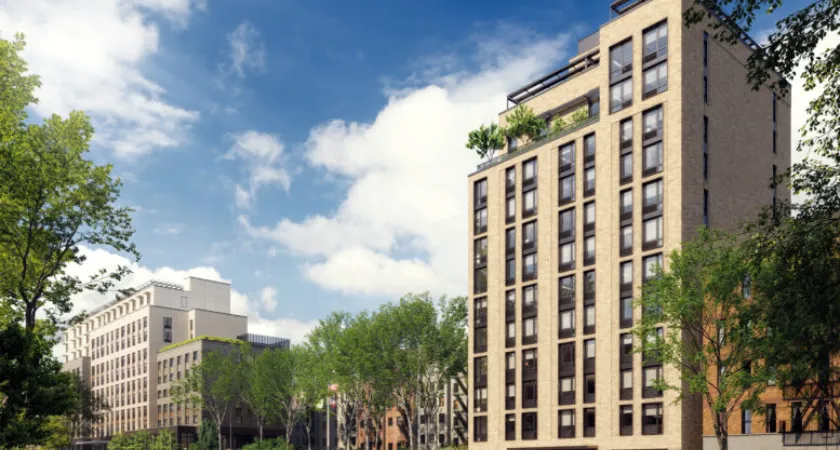
Construction is officially underway at 105 West 108th Street, where a new 13-story affordable housing development will rise on Manhattan’s Upper West Side, marking a key milestone in expanding supportive housing for older residents.
.webp)
Designed by Dattner Architects and developed by the West Side Federation for Senior and Supportive Housing (WSFSSH), the project will deliver 84 permanent housing units for seniors. The majority of apartments are designated for adults aged 62 and older, while 40 units are reserved for individuals aged 55 and above who have experienced homelessness and are living with serious mental illness or substance use disorders.
The development represents the second phase of the broader WSFSSH campus and is being constructed on an interior lot near the intersection of West 108th Street and Columbus Avenue.
A groundbreaking ceremony brought together key city and state officials, including Deputy Mayor for Housing and Planning Leila Bozorg, Comptroller Mark Levine, Manhattan Borough President Brad Hoylman-Sigal, and State Senator Cordell Cleare, along with representatives from the NYC Department of Housing Preservation and Development.
The new building will feature a light-toned façade with a structured grid of vertically grouped windows, creating a modern yet understated residential design. A setback on the 11th floor will provide space for an outdoor terrace, while the structure will be capped with a bulkhead above a flat roofline.
The project replaces a deteriorating city-owned parking garage that has since been demolished, transforming an underutilized site into much-needed residential housing.
The broader WSFSSH campus already includes Valley Lodge at 143-145 West 108th Street, which provides shelter and supportive housing for older adults, along with a federally qualified health center operated by the Institute for Family Health.
The building is designed as a fully electric development that meets Passive House energy standards, targeting a 30% reduction in energy use compared to typical New York City residential buildings.
Inside, the project will include 22 studio apartments, 61 one-bedroom units, and a superintendent’s apartment. All units will be income-restricted, with residents paying no more than 30% of their income toward rent through project-based Section 8 vouchers.
Of the 83 affordable units available to tenants, 40 will be allocated as supportive housing for formerly homeless individuals through referrals from the New York City Department of Homeless Services and the Human Resources Administration. The remaining units will be offered through the city’s Housing Connect lottery system.
Residents will have access to a range of on-site amenities designed to support both independence and community engagement. These include social services, property management, a 24/7 staffed front desk, a community room, landscaped outdoor space, and shared laundry facilities.
The location also offers convenient access to public transportation, with the Cathedral Parkway (110th Street) subway station nearby, serving the B and C lines.
The development is expected to be completed by summer 2028.
This project reflects a growing trend in New York City toward integrating affordable housing with supportive services, particularly for vulnerable populations such as seniors and individuals transitioning out of homelessness.
By combining permanent housing with on-site services, developments like this aim to reduce long-term housing instability while also easing pressure on shelters and healthcare systems. The inclusion of Passive House standards also signals the city’s continued push toward energy-efficient, climate-conscious construction.
The project’s funding structure—drawing from city agencies, state programs, and private financial institutions—highlights the complexity of delivering affordable housing at scale. Partnerships with organizations such as Enterprise Community Partners, JPMorgan Chase, and Capital One Community Investments underscore the role of both public and private sectors in addressing housing shortages.
As demand for senior housing continues to rise alongside an aging population, developments like 105 West 108th Street are likely to become an increasingly important part of urban housing strategies.
Originally reported by Michael Young in New York Yimby.