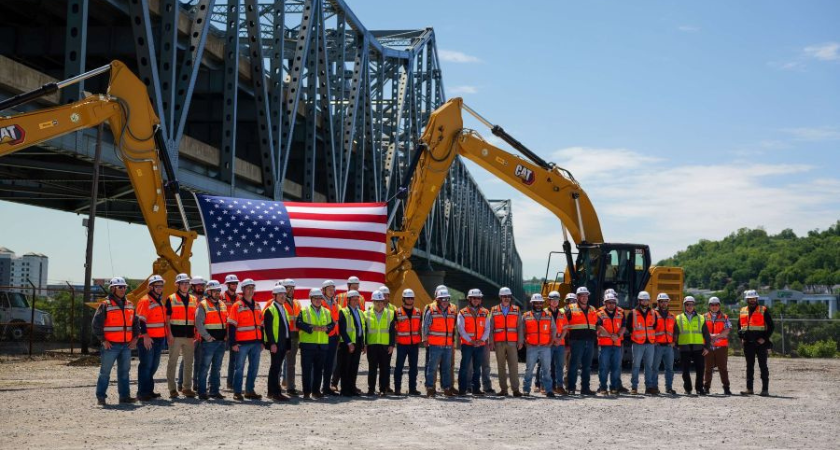

A $4.05 billion transportation overhaul spanning the Ohio River between Kentucky and Ohio is officially moving into construction, marking one of the most significant freight infrastructure investments in the United States.
The Brent Spence Corridor Project, led by Walsh Group and Kokosing Industrial, will deliver a new cable-stayed companion bridge alongside major upgrades to the existing Brent Spence Bridge and surrounding interstate network.
The project sits on Interstate 71/75, one of the most heavily trafficked freight and commuter corridors in the country, carrying an estimated $1 billion in goods daily.
Rather than a single bridge replacement, the program involves a full corridor redesign. Scope includes reconstruction of ramps, modernization of overpasses and underpasses, and improvements to both local and interstate traffic flow systems.
The companion bridge will serve as a new primary freight and mobility structure while the existing bridge is rehabilitated, allowing continued operation throughout construction.
This phased approach reflects the complexity of maintaining uninterrupted traffic on a critical national logistics route while executing large-scale structural replacement.
The project is backed by a combination of federal and state funding, including $1.63 billion in federal grants, alongside contributions from Ohio and Kentucky transportation agencies.
With an estimated 6 million work hours required and a peak workforce approaching 1,000 skilled tradespeople, the program represents one of the largest active heavy civil construction efforts in the country.
Completion is expected in phases, with the companion bridge targeted for 2031 and broader corridor improvements extending into 2033.
The use of a design-build delivery model reflects the need for integrated planning across engineering, construction sequencing, and traffic management.
With live interstate traffic, freight continuity requirements, and multiple public stakeholders, early contractor involvement is critical to managing risk, maintaining schedule integrity, and minimizing disruption to regional and national logistics flows.
The approach also enables coordinated phasing of structural work, reducing downtime on one of the nation’s most economically significant transportation links.
The Brent Spence Corridor Project highlights a broader national trend in infrastructure investment: transportation corridors are increasingly viewed as economic engines rather than standalone assets.
High-volume freight routes are becoming focal points for federal and state funding strategies aimed at improving supply chain efficiency, reducing congestion, and supporting manufacturing and logistics competitiveness.
For contractors, these corridor-scale programs introduce long-duration workload pipelines but also intensify competition for labor, equipment, and specialized bridge construction expertise.
For construction owners and infrastructure developers, the Brent Spence project reinforces a shift toward corridor-scale thinking in transportation delivery.
Future infrastructure investments are increasingly likely to focus on regional systems rather than isolated assets, requiring owners to manage multi-jurisdiction coordination, long-term phasing, and continuous operations during construction.
Projects of this scale also highlight the importance of integrated design-build delivery models, especially where freight movement, economic output, and public safety are directly tied to construction performance.
Owners who can manage complexity across multiple stakeholders and maintain operational continuity during execution will be better positioned in the next generation of infrastructure programs.
Originally reported by Walsh Group.